Cyclobarbital: Difference between revisions
CSV import |
CSV import |
||
| Line 24: | Line 24: | ||
[[Category:Chemical compounds]] | [[Category:Chemical compounds]] | ||
{{medicine-stub}} | {{medicine-stub}} | ||
<gallery> | |||
File:Cyclobarbital.svg|Cyclobarbital | |||
File:Cyclobarbital ball-and-stick.png|Cyclobarbital ball-and-stick model | |||
</gallery> | |||
Latest revision as of 01:00, 20 February 2025
Cyclobarbital, also known as cyclobarbitone in some regions, is a barbiturate derivative used primarily as a sedative and hypnotic. It was first synthesized in the early 20th century and has been utilized in the treatment of insomnia and as a component in some anesthetic protocols. Like other barbiturates, cyclobarbital acts by enhancing the action of GABA (gamma-aminobutyric acid), a neurotransmitter that inhibits the activity of neurons, leading to sedation and hypnosis.
Chemical Properties[edit]
Cyclobarbital is chemically known as 5-(1-cyclohexen-1-yl)-1,5-dimethylbarbituric acid. It is a white, crystalline substance that is soluble in alcohol and ether but relatively insoluble in water. Its molecular formula is C12H16N2O3.
Pharmacology[edit]
The pharmacological action of cyclobarbital involves the potentiation of GABAergic neurotransmission, which in turn leads to the depression of the central nervous system (CNS). This results in sedative, hypnotic, and anticonvulsant effects. Cyclobarbital's onset of action is relatively rapid, and its effects can last for several hours, making it effective for the induction of sleep and maintenance of sedation.
Clinical Uses[edit]
Cyclobarbital has been used for the treatment of insomnia and as a pre-anesthetic medication to induce sedation before surgical procedures. However, its use has declined over the years due to the development of newer drugs with fewer side effects and lower risk of dependence.
Side Effects and Risks[edit]
The use of cyclobarbital, like other barbiturates, is associated with a range of side effects including drowsiness, dizziness, and impaired coordination. Long-term use or abuse can lead to dependence and withdrawal symptoms upon cessation. Overdose can result in severe respiratory depression, coma, and death. Due to these risks, cyclobarbital is now less commonly prescribed, with preference given to benzodiazepines and other non-barbiturate sedatives.
Regulation and Control[edit]
Cyclobarbital is classified as a controlled substance in many countries, subject to regulations that govern its prescription and distribution. Its potential for abuse and dependence has led to strict controls to minimize misuse.
Conclusion[edit]
While cyclobarbital played an important role in the management of insomnia and as a sedative in the past, its use today is limited due to the availability of safer alternatives. Its history in medicine, however, provides valuable insights into the development of sedative-hypnotic drugs and the evolution of pharmacotherapy in sleep disorders.

-
 Cyclobarbital
 -
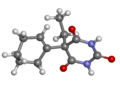 Cyclobarbital ball-and-stick model


