Basbousa: Difference between revisions
CSV import |
CSV import |
||
| Line 21: | Line 21: | ||
{{MiddleEast-food-stub}} | {{MiddleEast-food-stub}} | ||
{{food-stub}} | {{food-stub}} | ||
<gallery> | |||
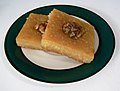
File:Basboosa.jpg|Basbousa | |||
</gallery> | |||
Latest revision as of 00:49, 20 February 2025
Basbousa is a traditional Middle Eastern sweet cake, made from cooked semolina or farina soaked in simple syrup. Its name derives from the Arabic word for 'just a little', due to the small amount of semolina used in the recipe. It is popular in the cuisines of the Levant, the Arabian Peninsula, and North Africa.
Ingredients and Preparation[edit]
The primary ingredients of basbousa are semolina, sugar, and yogurt or milk. Some variations may include coconut, orange flower water, or rose water. The cake is typically cut into diamond shapes and often topped with an almond or a walnut.
To prepare basbousa, semolina, baking powder, and a pinch of salt are mixed together in a bowl. In a separate bowl, sugar and yogurt are combined until the sugar is fully dissolved. The semolina mixture is then added to the yogurt mixture and mixed until well combined. The batter is poured into a greased baking dish and smoothed out with a spatula. The dish is then baked until the cake is golden brown. Once removed from the oven, simple syrup is poured over the hot cake, allowing it to soak in and give the cake its distinctive sweet taste.
Cultural Significance[edit]
Basbousa is often served during special occasions and celebrations such as Eid al-Fitr, the feast marking the end of Ramadan. It is also a common dessert in Coptic Christian communities, particularly during the fasting periods, as it is free of animal products.
Variations[edit]
There are many regional variations of basbousa. In Turkey, it is known as revani, in Greece it is called ravani, and in Armenia, the cake is named shamali. The Egyptian version of basbousa is often made without coconut, while the Lebanese and Syrian versions of the cake often include it.
See Also[edit]
This Middle Eastern food related article is a stub. You can help WikiMD by expanding it.

-
 Basbousa

