Acheiropodia: Difference between revisions
CSV import |
CSV import |
||
| Line 46: | Line 46: | ||
[[Category:Rare diseases]] | [[Category:Rare diseases]] | ||
[[Category:Congenital disorders]] | [[Category:Congenital disorders]] | ||
== Acheiropodia == | |||
<gallery> | |||
File:Autorecessive.svg|Autorecessive | |||
File:Acheiropodia Mutation.svg|Acheiropodia Mutation | |||
File:Acheiropodia Chromatin Architecture (TAD).jpg|Acheiropodia Chromatin Architecture (TAD) | |||
</gallery> | |||
Latest revision as of 00:41, 20 February 2025
| Acheiropodia | |
|---|---|
| Synonyms | N/A |
| Pronounce | N/A |
| Specialty | N/A |
| Symptoms | Congenital absence of hands and feet |
| Complications | N/A |
| Onset | Birth |
| Duration | Lifelong |
| Types | N/A |
| Causes | Genetic mutation |
| Risks | N/A |
| Diagnosis | Clinical examination, Genetic testing |
| Differential diagnosis | N/A |
| Prevention | N/A |
| Treatment | Supportive care |
| Medication | N/A |
| Prognosis | N/A |
| Frequency | Rare disease |
| Deaths | N/A |
Acheiropodia is a rare genetic disorder characterized by the congenital absence of hands and feet. This condition is inherited in an autosomal recessive pattern and is caused by mutations in the LMBR1 gene.
Presentation[edit]
Individuals with acheiropodia are born without hands and feet, a condition known as amelia. The absence of these limbs is due to a disruption in the normal development of the limb bud during embryogenesis.
Genetics[edit]
Acheiropodia is caused by mutations in the LMBR1 gene, which is located on chromosome 7. This gene is involved in the sonic hedgehog signaling pathway, which plays a crucial role in the development of limbs. The condition follows an autosomal recessive inheritance pattern, meaning that an individual must inherit two copies of the mutated gene, one from each parent, to be affected.
Diagnosis[edit]
Diagnosis of acheiropodia is primarily based on clinical examination and the characteristic absence of hands and feet. Genetic testing can confirm the diagnosis by identifying mutations in the LMBR1 gene.
Management[edit]
There is no cure for acheiropodia, and management focuses on supportive care to improve the quality of life for affected individuals. This may include the use of prosthetic devices, physical therapy, and occupational therapy to enhance mobility and independence.
Epidemiology[edit]
Acheiropodia is an extremely rare condition, with only a few cases reported in the medical literature. It is more commonly observed in certain isolated populations where consanguinity is more prevalent.
See also[edit]
References[edit]
<references />
External links[edit]
Acheiropodia[edit]
-
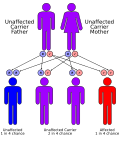 Autorecessive
 -
Acheiropodia Mutation
-
Acheiropodia Chromatin Architecture (TAD)


.jpg)