Anamirta cocculus: Difference between revisions
CSV import |
CSV import |
||
| Line 5: | Line 5: | ||
File:Anamirta_cocculus_003.JPG|Anamirta cocculus | File:Anamirta_cocculus_003.JPG|Anamirta cocculus | ||
</gallery> | </gallery> | ||
==Anamirta cocculus== | |||
'''''Anamirta cocculus''''' is a species of flowering plant in the family [[Menispermaceae]]. It is native to the tropical regions of [[South and Southeast Asia]], including countries such as [[India]], [[Sri Lanka]], [[Myanmar]], [[Thailand]], and [[Indonesia]]. The plant is known for its toxic seeds, which have been historically used for various purposes. | |||
===Description=== | |||
''Anamirta cocculus'' is a large, woody [[climber]] that can grow up to 10 meters in length. The plant has a thick, corky bark and large, heart-shaped leaves that are alternately arranged. The leaves are dark green and can grow up to 30 cm in length. The plant produces small, greenish-white flowers that are arranged in clusters. The fruit is a drupe, which contains a single seed known as the "cocculus indicus." | |||
===Toxicity=== | |||
The seeds of ''Anamirta cocculus'', commonly referred to as "cocculus indicus," contain the toxic compound [[picrotoxin]]. Picrotoxin is a potent [[neurotoxin]] that acts as a non-competitive antagonist of the [[GABA]] receptor, leading to [[convulsions]] and [[seizures]] if ingested. Due to its toxic properties, the seeds have been used historically as a [[fish poison]] and as an [[insecticide]]. | |||
===Uses=== | |||
Despite its toxicity, ''Anamirta cocculus'' has been used in traditional medicine in some cultures. It has been employed as a treatment for [[lice]] and [[scabies]], and in some cases, as a [[stimulant]]. However, due to the high risk of toxicity, its use in modern medicine is limited. | |||
===Historical Context=== | |||
In the past, the seeds of ''Anamirta cocculus'' were used to adulterate [[beer]] and [[wine]] to enhance their intoxicating effects. This practice was eventually banned due to the dangerous side effects associated with picrotoxin poisoning. | |||
==Related pages== | |||
* [[Menispermaceae]] | |||
* [[Picrotoxin]] | |||
* [[Neurotoxin]] | |||
* [[Traditional medicine]] | |||
{{Taxonbar|from=Q1341465}} | |||
[[Category:Menispermaceae]] | |||
[[Category:Flora of Asia]] | |||
[[Category:Poisonous plants]] | |||
Latest revision as of 00:42, 19 February 2025
-
 Illustration of Anamirta cocculus from Köhler's Medicinal Plants
 -
 Close-up of Anamirta cocculus fruits
 -
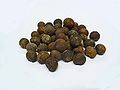 Anamirta cocculus
 -
 Anamirta cocculus

_fruits_closeup_ruled.JPG)


Anamirta cocculus[edit]
Anamirta cocculus is a species of flowering plant in the family Menispermaceae. It is native to the tropical regions of South and Southeast Asia, including countries such as India, Sri Lanka, Myanmar, Thailand, and Indonesia. The plant is known for its toxic seeds, which have been historically used for various purposes.
Description[edit]
Anamirta cocculus is a large, woody climber that can grow up to 10 meters in length. The plant has a thick, corky bark and large, heart-shaped leaves that are alternately arranged. The leaves are dark green and can grow up to 30 cm in length. The plant produces small, greenish-white flowers that are arranged in clusters. The fruit is a drupe, which contains a single seed known as the "cocculus indicus."
Toxicity[edit]
The seeds of Anamirta cocculus, commonly referred to as "cocculus indicus," contain the toxic compound picrotoxin. Picrotoxin is a potent neurotoxin that acts as a non-competitive antagonist of the GABA receptor, leading to convulsions and seizures if ingested. Due to its toxic properties, the seeds have been used historically as a fish poison and as an insecticide.
Uses[edit]
Despite its toxicity, Anamirta cocculus has been used in traditional medicine in some cultures. It has been employed as a treatment for lice and scabies, and in some cases, as a stimulant. However, due to the high risk of toxicity, its use in modern medicine is limited.
Historical Context[edit]
In the past, the seeds of Anamirta cocculus were used to adulterate beer and wine to enhance their intoxicating effects. This practice was eventually banned due to the dangerous side effects associated with picrotoxin poisoning.
