Anaplastic large-cell lymphoma: Difference between revisions
CSV import |
CSV import |
||
| Line 4: | Line 4: | ||
File:Anaplastic_Large_Cell_Lymphoma_CD30.jpg|Anaplastic large-cell lymphoma CD30 positive | File:Anaplastic_Large_Cell_Lymphoma_CD30.jpg|Anaplastic large-cell lymphoma CD30 positive | ||
</gallery> | </gallery> | ||
== Anaplastic Large-Cell Lymphoma == | |||
'''Anaplastic large-cell lymphoma''' (ALCL) is a type of [[non-Hodgkin lymphoma]] that is characterized by the presence of large, atypical lymphoid cells. It is a rare form of lymphoma that can occur in both children and adults. ALCL is classified as a T-cell lymphoma, meaning it originates from [[T lymphocytes]], a type of white blood cell that plays a crucial role in the immune system. | |||
=== Classification === | |||
ALCL is divided into two main types based on the presence or absence of a specific genetic abnormality involving the [[anaplastic lymphoma kinase]] (ALK) gene: | |||
* '''ALK-positive ALCL''': This type is more common in children and young adults. It is characterized by the presence of a translocation involving the ALK gene, which leads to the expression of an abnormal ALK protein that promotes cell growth and survival. | |||
* '''ALK-negative ALCL''': This type is more common in older adults and does not have the ALK gene rearrangement. It tends to have a more aggressive clinical course compared to ALK-positive ALCL. | |||
=== Clinical Presentation === | |||
Patients with ALCL may present with a variety of symptoms, including: | |||
* [[Lymphadenopathy]]: Swelling of the lymph nodes, which may be painless. | |||
* [[B symptoms]]: Fever, night sweats, and weight loss. | |||
* Extranodal involvement: ALCL can affect organs outside the lymphatic system, such as the skin, liver, lungs, and bones. | |||
=== Diagnosis === | |||
The diagnosis of ALCL is made through a combination of clinical evaluation, imaging studies, and [[biopsy]] of affected tissue. Histological examination reveals large, pleomorphic cells with abundant cytoplasm and horseshoe-shaped nuclei. Immunohistochemistry is used to detect the expression of CD30, a marker that is typically positive in ALCL cells. | |||
=== Treatment === | |||
The treatment of ALCL depends on the subtype and stage of the disease. Common treatment options include: | |||
* [[Chemotherapy]]: Regimens such as CHOP (cyclophosphamide, doxorubicin, vincristine, and prednisone) are commonly used. | |||
* Targeted therapy: For ALK-positive ALCL, ALK inhibitors such as crizotinib may be used. | |||
* [[Radiation therapy]]: May be used in certain cases, especially for localized disease. | |||
* [[Stem cell transplantation]]: Considered in cases of relapsed or refractory ALCL. | |||
=== Prognosis === | |||
The prognosis of ALCL varies depending on the subtype and other factors such as age and overall health. ALK-positive ALCL generally has a better prognosis compared to ALK-negative ALCL. Long-term survival rates are higher in children and young adults compared to older patients. | |||
== Related Pages == | |||
* [[Non-Hodgkin lymphoma]] | |||
* [[T-cell lymphoma]] | |||
* [[Lymphadenopathy]] | |||
* [[Chemotherapy]] | |||
{{Lymphoma}} | |||
[[Category:Lymphoma]] | |||
[[Category:Hematology]] | |||
Revision as of 00:40, 19 February 2025
Anaplastic_large-cell_lymphoma
-
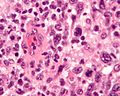 Anaplastic large-cell lymphoma under very high magnification
 -
 Anaplastic large-cell lymphoma CD30 positive


Anaplastic Large-Cell Lymphoma
Anaplastic large-cell lymphoma (ALCL) is a type of non-Hodgkin lymphoma that is characterized by the presence of large, atypical lymphoid cells. It is a rare form of lymphoma that can occur in both children and adults. ALCL is classified as a T-cell lymphoma, meaning it originates from T lymphocytes, a type of white blood cell that plays a crucial role in the immune system.
Classification
ALCL is divided into two main types based on the presence or absence of a specific genetic abnormality involving the anaplastic lymphoma kinase (ALK) gene:
- ALK-positive ALCL: This type is more common in children and young adults. It is characterized by the presence of a translocation involving the ALK gene, which leads to the expression of an abnormal ALK protein that promotes cell growth and survival.
- ALK-negative ALCL: This type is more common in older adults and does not have the ALK gene rearrangement. It tends to have a more aggressive clinical course compared to ALK-positive ALCL.
Clinical Presentation
Patients with ALCL may present with a variety of symptoms, including:
- Lymphadenopathy: Swelling of the lymph nodes, which may be painless.
- B symptoms: Fever, night sweats, and weight loss.
- Extranodal involvement: ALCL can affect organs outside the lymphatic system, such as the skin, liver, lungs, and bones.
Diagnosis
The diagnosis of ALCL is made through a combination of clinical evaluation, imaging studies, and biopsy of affected tissue. Histological examination reveals large, pleomorphic cells with abundant cytoplasm and horseshoe-shaped nuclei. Immunohistochemistry is used to detect the expression of CD30, a marker that is typically positive in ALCL cells.
Treatment
The treatment of ALCL depends on the subtype and stage of the disease. Common treatment options include:
- Chemotherapy: Regimens such as CHOP (cyclophosphamide, doxorubicin, vincristine, and prednisone) are commonly used.
- Targeted therapy: For ALK-positive ALCL, ALK inhibitors such as crizotinib may be used.
- Radiation therapy: May be used in certain cases, especially for localized disease.
- Stem cell transplantation: Considered in cases of relapsed or refractory ALCL.
Prognosis
The prognosis of ALCL varies depending on the subtype and other factors such as age and overall health. ALK-positive ALCL generally has a better prognosis compared to ALK-negative ALCL. Long-term survival rates are higher in children and young adults compared to older patients.
Related Pages
| Lymphomas | ||||||||
|---|---|---|---|---|---|---|---|---|
This lymphoma-related article is a stub.
|
