Amebocyte: Difference between revisions
CSV import Tags: mobile edit mobile web edit |
CSV import |
||
| Line 3: | Line 3: | ||
File:The_Biological_bulletin_(20191724949).jpg|Amebocyte | File:The_Biological_bulletin_(20191724949).jpg|Amebocyte | ||
</gallery> | </gallery> | ||
== Amebocyte == | |||
An '''amebocyte''' (or '''amoebocyte''') is a type of cell that moves like an [[amoeba]], using pseudopodia. These cells are found in a variety of organisms, including [[invertebrates]] and some [[vertebrates]]. Amebocytes play crucial roles in the [[immune system]], [[digestion]], and other physiological processes. | |||
== Function == | |||
Amebocytes are primarily involved in the [[immune response]] of organisms. They are capable of [[phagocytosis]], a process where the cell engulfs and digests foreign particles, such as [[bacteria]] and [[dead cells]]. This function is vital for protecting the organism from infections and maintaining homeostasis. | |||
In addition to their role in the immune system, amebocytes are involved in the distribution of nutrients. In some species, they transport [[nutrients]] from the digestive tract to other parts of the body. This is particularly important in organisms with less complex circulatory systems. | |||
== Types of Amebocytes == | |||
Amebocytes can be found in various forms across different species: | |||
* '''[[Coelomocytes]]''': Found in the coelomic fluid of [[echinoderms]], these amebocytes are involved in immune responses and wound repair. | |||
* '''[[Hemocytes]]''': Present in the [[hemolymph]] of [[arthropods]], hemocytes are responsible for clotting and defense against pathogens. | |||
* '''[[Schizocytes]]''': Found in [[annelids]], these cells are involved in the breakdown of [[hemoglobin]] and other metabolic processes. | |||
== Role in Horseshoe Crabs == | |||
In [[horseshoe crabs]], amebocytes are of particular interest due to their use in the [[Limulus amebocyte lysate]] (LAL) test. This test is used to detect [[endotoxins]] in medical applications. The amebocytes of horseshoe crabs contain a clotting agent that reacts to bacterial endotoxins, making them invaluable for ensuring the safety of [[pharmaceuticals]] and medical devices. | |||
== Related Pages == | |||
* [[Immune system]] | |||
* [[Phagocytosis]] | |||
* [[Horseshoe crab]] | |||
* [[Limulus amebocyte lysate]] | |||
* [[Invertebrate]] | |||
{{Cell-biology-stub}} | |||
[[Category:Cell biology]] | |||
[[Category:Immunology]] | |||
Latest revision as of 00:38, 19 February 2025
-
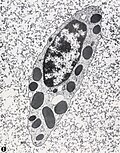 Amebocyte
 -
 Amebocyte
.jpg)
.jpg)
Amebocyte[edit]
An amebocyte (or amoebocyte) is a type of cell that moves like an amoeba, using pseudopodia. These cells are found in a variety of organisms, including invertebrates and some vertebrates. Amebocytes play crucial roles in the immune system, digestion, and other physiological processes.
Function[edit]
Amebocytes are primarily involved in the immune response of organisms. They are capable of phagocytosis, a process where the cell engulfs and digests foreign particles, such as bacteria and dead cells. This function is vital for protecting the organism from infections and maintaining homeostasis.
In addition to their role in the immune system, amebocytes are involved in the distribution of nutrients. In some species, they transport nutrients from the digestive tract to other parts of the body. This is particularly important in organisms with less complex circulatory systems.
Types of Amebocytes[edit]
Amebocytes can be found in various forms across different species:
- Coelomocytes: Found in the coelomic fluid of echinoderms, these amebocytes are involved in immune responses and wound repair.
- Hemocytes: Present in the hemolymph of arthropods, hemocytes are responsible for clotting and defense against pathogens.
- Schizocytes: Found in annelids, these cells are involved in the breakdown of hemoglobin and other metabolic processes.
Role in Horseshoe Crabs[edit]
In horseshoe crabs, amebocytes are of particular interest due to their use in the Limulus amebocyte lysate (LAL) test. This test is used to detect endotoxins in medical applications. The amebocytes of horseshoe crabs contain a clotting agent that reacts to bacterial endotoxins, making them invaluable for ensuring the safety of pharmaceuticals and medical devices.
Related Pages[edit]

This article is a cell biology stub. You can help WikiMD by expanding it!
