Amaranthus caudatus: Difference between revisions
CSV import |
CSV import |
||
| Line 4: | Line 4: | ||
File:Amaranthus_kiwicha.jpg|Amaranthus caudatus plant | File:Amaranthus_kiwicha.jpg|Amaranthus caudatus plant | ||
</gallery> | </gallery> | ||
==Amaranthus caudatus== | |||
'''''Amaranthus caudatus''''', commonly known as [[love-lies-bleeding]], is a species of flowering plant in the [[Amaranthaceae]] family. It is native to the [[Andes]] region of [[South America]], where it has been cultivated for thousands of years as a grain crop. The plant is notable for its striking, drooping inflorescences and its nutritional seeds. | |||
===Description=== | |||
''Amaranthus caudatus'' is an annual plant that can grow to a height of 1 to 2 meters. The plant has broad, alternate leaves that are ovate to rhomboid in shape. The most distinctive feature of ''A. caudatus'' is its long, tassel-like inflorescences, which can be red, purple, or green. These inflorescences can reach lengths of up to 50 cm and hang down from the plant, giving it a unique appearance. | |||
The seeds of ''Amaranthus caudatus'' are small, lens-shaped, and typically pale in color. They are rich in protein and essential amino acids, making them a valuable food source. | |||
===Cultivation=== | |||
''Amaranthus caudatus'' is cultivated primarily for its seeds, which are used as a [[pseudocereal]]. It is grown in a variety of climates, from temperate to tropical regions. The plant prefers well-drained soil and full sun exposure. It is relatively drought-tolerant and can be grown in areas with low rainfall. | |||
The seeds are harvested when the inflorescences begin to dry and the seeds can be easily threshed. The seeds are then cleaned and can be used in a variety of culinary applications. | |||
===Uses=== | |||
The seeds of ''Amaranthus caudatus'' are highly nutritious and are used in a variety of dishes. They can be ground into flour, popped like popcorn, or cooked whole. The seeds are gluten-free, making them suitable for people with [[celiac disease]] or gluten intolerance. | |||
In addition to its use as a food source, ''A. caudatus'' is also grown as an ornamental plant due to its striking appearance. The plant's vibrant inflorescences make it a popular choice for gardens and floral arrangements. | |||
===Nutritional Value=== | |||
''Amaranthus caudatus'' seeds are rich in protein, containing about 13-15% protein by weight. They are also a good source of [[lysine]], an essential amino acid that is often lacking in other grains. The seeds contain a variety of vitamins and minerals, including [[calcium]], [[iron]], and [[magnesium]]. | |||
===Cultural Significance=== | |||
In the Andes, ''Amaranthus caudatus'' has been an important crop for indigenous peoples for centuries. It is often associated with traditional festivals and rituals. The plant is sometimes referred to as "kiwicha" in [[Quechua]], the language of the [[Inca Empire]]. | |||
==Related pages== | |||
* [[Amaranthaceae]] | |||
* [[Pseudocereal]] | |||
* [[Celiac disease]] | |||
* [[Andes]] | |||
{{Amaranthaceae}} | |||
[[Category:Amaranthaceae]] | |||
[[Category:Flora of South America]] | |||
[[Category:Edible plants]] | |||
[[Category:Grains]] | |||
Latest revision as of 00:37, 19 February 2025
Amaranthus_caudatus[edit]
-
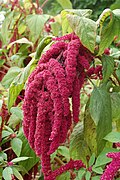 Amaranthus caudatus in bloom
 -
 Amaranthus caudatus plant
.JPG)

Amaranthus caudatus[edit]
Amaranthus caudatus, commonly known as love-lies-bleeding, is a species of flowering plant in the Amaranthaceae family. It is native to the Andes region of South America, where it has been cultivated for thousands of years as a grain crop. The plant is notable for its striking, drooping inflorescences and its nutritional seeds.
Description[edit]
Amaranthus caudatus is an annual plant that can grow to a height of 1 to 2 meters. The plant has broad, alternate leaves that are ovate to rhomboid in shape. The most distinctive feature of A. caudatus is its long, tassel-like inflorescences, which can be red, purple, or green. These inflorescences can reach lengths of up to 50 cm and hang down from the plant, giving it a unique appearance.
The seeds of Amaranthus caudatus are small, lens-shaped, and typically pale in color. They are rich in protein and essential amino acids, making them a valuable food source.
Cultivation[edit]
Amaranthus caudatus is cultivated primarily for its seeds, which are used as a pseudocereal. It is grown in a variety of climates, from temperate to tropical regions. The plant prefers well-drained soil and full sun exposure. It is relatively drought-tolerant and can be grown in areas with low rainfall.
The seeds are harvested when the inflorescences begin to dry and the seeds can be easily threshed. The seeds are then cleaned and can be used in a variety of culinary applications.
Uses[edit]
The seeds of Amaranthus caudatus are highly nutritious and are used in a variety of dishes. They can be ground into flour, popped like popcorn, or cooked whole. The seeds are gluten-free, making them suitable for people with celiac disease or gluten intolerance.
In addition to its use as a food source, A. caudatus is also grown as an ornamental plant due to its striking appearance. The plant's vibrant inflorescences make it a popular choice for gardens and floral arrangements.
Nutritional Value[edit]
Amaranthus caudatus seeds are rich in protein, containing about 13-15% protein by weight. They are also a good source of lysine, an essential amino acid that is often lacking in other grains. The seeds contain a variety of vitamins and minerals, including calcium, iron, and magnesium.
Cultural Significance[edit]
In the Andes, Amaranthus caudatus has been an important crop for indigenous peoples for centuries. It is often associated with traditional festivals and rituals. The plant is sometimes referred to as "kiwicha" in Quechua, the language of the Inca Empire.
