Althaea officinalis: Difference between revisions
CSV import |
CSV import |
||
| Line 13: | Line 13: | ||
File:Althaea_officinalis_2019-12-13_5769.jpg|Althaea officinalis | File:Althaea_officinalis_2019-12-13_5769.jpg|Althaea officinalis | ||
</gallery> | </gallery> | ||
== Althaea officinalis == | |||
'''Althaea officinalis''', commonly known as '''marshmallow''', is a perennial species indigenous to Europe, Western Asia, and North Africa. It is well-known for its medicinal properties and has been used in traditional medicine for centuries. | |||
== Description == | |||
''Althaea officinalis'' is a herbaceous perennial plant that typically grows to a height of 1.5 meters. The plant has a branching stem and broad, velvety leaves that are palmately lobed. The flowers are pale pink to white and bloom in late summer. The plant thrives in marshy areas, hence its common name, marshmallow. | |||
== Cultivation == | |||
''Althaea officinalis'' prefers moist, well-drained soil and can be grown in full sun to partial shade. It is often cultivated in gardens for its ornamental flowers and medicinal roots. The plant is hardy and can tolerate a range of soil types, although it prefers slightly alkaline conditions. | |||
== Uses == | |||
=== Medicinal === | |||
The roots of ''Althaea officinalis'' contain mucilage, which has been used traditionally to soothe irritated mucous membranes. It is commonly used in herbal medicine to treat coughs, sore throats, and digestive issues. The leaves and flowers also have medicinal properties and can be used in teas and poultices. | |||
=== Culinary === | |||
Historically, the root of ''Althaea officinalis'' was used to make a confection that evolved into the modern marshmallow candy. The mucilaginous root was boiled and sweetened to create a soft, spongy treat. | |||
== Related pages == | |||
* [[Herbal medicine]] | |||
* [[Perennial plant]] | |||
* [[Mucilage]] | |||
* [[Traditional medicine]] | |||
{{Taxonbar}} | |||
[[Category:Malvaceae]] | |||
[[Category:Medicinal plants]] | |||
[[Category:Flora of Europe]] | |||
[[Category:Flora of Asia]] | |||
[[Category:Flora of North Africa]] | |||
Latest revision as of 00:34, 19 February 2025
-
 Althaea officinalis
 -
 Althaea officinalis
 -
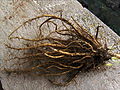 Althaea officinalis
 -
 Althaea officinalis
 -
 Althaea officinalis
 -
 Althaea officinalis
 -
 Althaea officinalis
 -
 Althaea officinalis
 -
 Althaea officinalis
 -
 Althaea officinalis
 -
 Althaea officinalis
 -
 Althaea officinalis


.jpg)
,_Guilford,_CT_(42861186434).jpg)


Althaea officinalis[edit]
Althaea officinalis, commonly known as marshmallow, is a perennial species indigenous to Europe, Western Asia, and North Africa. It is well-known for its medicinal properties and has been used in traditional medicine for centuries.
Description[edit]
Althaea officinalis is a herbaceous perennial plant that typically grows to a height of 1.5 meters. The plant has a branching stem and broad, velvety leaves that are palmately lobed. The flowers are pale pink to white and bloom in late summer. The plant thrives in marshy areas, hence its common name, marshmallow.
Cultivation[edit]
Althaea officinalis prefers moist, well-drained soil and can be grown in full sun to partial shade. It is often cultivated in gardens for its ornamental flowers and medicinal roots. The plant is hardy and can tolerate a range of soil types, although it prefers slightly alkaline conditions.
Uses[edit]
Medicinal[edit]
The roots of Althaea officinalis contain mucilage, which has been used traditionally to soothe irritated mucous membranes. It is commonly used in herbal medicine to treat coughs, sore throats, and digestive issues. The leaves and flowers also have medicinal properties and can be used in teas and poultices.
Culinary[edit]
Historically, the root of Althaea officinalis was used to make a confection that evolved into the modern marshmallow candy. The mucilaginous root was boiled and sweetened to create a soft, spongy treat.
