Transfer-messenger RNA: Difference between revisions
CSV import |
CSV import |
||
| Line 56: | Line 56: | ||
[[Category:RNA]] | [[Category:RNA]] | ||
[[Category:Molecular biology]] | [[Category:Molecular biology]] | ||
<gallery> | |||
File:157-TransferMessengerRNA_3iyr_composite.tif|Transfer-messenger RNA composite structure | |||
File:tRNAmRNAtmRNAComparison.png|Comparison of tRNA, mRNA, and tmRNA | |||
File:EsccolitmRNA2009.png|Escherichia coli tmRNA structure | |||
File:TDLcartoonstructure.png|Transfer-messenger RNA TDL cartoon structure | |||
File:SmpBcartoonstructure.png|SmpB protein cartoon structure | |||
File:Transtranslation.png|Transfer-messenger RNA translation process | |||
File:ssraHistory2.jpg|History of ssrA gene discovery | |||
File:Secondary_structure_models_for_mt-tmRNAs..jpg|Secondary structure models for mitochondrial tmRNAs | |||
File:Processing_of_two-piece_mt-tmRNA..jpg|Processing of two-piece mitochondrial tmRNA | |||
</gallery> | |||
Latest revision as of 12:18, 18 February 2025
Transfer-messenger RNA[edit]

Transfer-messenger RNA (tmRNA) is a unique type of RNA molecule found in bacteria and archaea. It plays a crucial role in the process of trans-translation, which rescues ribosomes stalled on damaged mRNA and tags incomplete polypeptides for degradation.
Structure[edit]

The tmRNA molecule is a hybrid of transfer RNA (tRNA) and messenger RNA (mRNA). It contains a tRNA-like domain (TLD) that can be charged with an amino acid, and an mRNA-like region that encodes a short peptide tag. The structure of tmRNA allows it to mimic both tRNA and mRNA, facilitating its role in trans-translation.
Function[edit]
In the process of trans-translation, tmRNA, along with the protein SmpB, binds to stalled ribosomes. The tRNA-like domain of tmRNA enters the ribosome's A site, allowing the ribosome to switch from the defective mRNA to the mRNA-like region of tmRNA. This results in the addition of a peptide tag to the nascent polypeptide, marking it for degradation by cellular proteases.
Mechanism of Action[edit]


The trans-translation process begins when a ribosome stalls on a defective mRNA. The tmRNA-SmpB complex recognizes the stalled ribosome and enters the A site. The ribosome then shifts to the mRNA-like region of tmRNA, which encodes a short peptide sequence. This sequence is translated, and the resulting tagged polypeptide is released and targeted for degradation.
Evolutionary Significance[edit]

The presence of tmRNA in both bacteria and archaea suggests that it is an ancient and conserved mechanism for dealing with stalled ribosomes. The ability to rescue stalled ribosomes and degrade incomplete proteins is crucial for maintaining cellular homeostasis and protein quality control.
History of Discovery[edit]
The discovery of tmRNA dates back to the late 1980s and early 1990s, when researchers identified a novel RNA molecule with properties of both tRNA and mRNA. Subsequent studies revealed its role in trans-translation and its importance in cellular processes.
Mitochondrial tmRNA[edit]

In some mitochondria, a variant of tmRNA exists, known as mitochondrial tmRNA (mt-tmRNA). These molecules have adapted to the unique environment of the mitochondrion and play a similar role in rescuing stalled ribosomes within this organelle.
Related Pages[edit]
References[edit]
<references group="" responsive="1"></references>
-
 Transfer-messenger RNA composite structure
 -
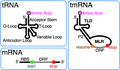 Comparison of tRNA, mRNA, and tmRNA
 -
Escherichia coli tmRNA structure
-
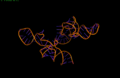 Transfer-messenger RNA TDL cartoon structure
 -
 SmpB protein cartoon structure
 -
 Transfer-messenger RNA translation process
 -
History of ssrA gene discovery
-
 Secondary structure models for mitochondrial tmRNAs
 -
 Processing of two-piece mitochondrial tmRNA


