Indian club: Difference between revisions
CSV import |
CSV import |
||
| Line 28: | Line 28: | ||
[[Category:Strength training]] | [[Category:Strength training]] | ||
[[Category:Physical fitness]] | [[Category:Physical fitness]] | ||
<gallery caption="Indian_club"> | |||
File:Indian_clubs.jpg|Indian clubs | |||
File:Stone_Figure_-_5th-7th_Century_CE_-_Moghalmari_Artefact_-_Kolkata_2014-09-14_7873.JPG|Stone figure from 5th-7th Century CE | |||
File:Pahlavan_takhti_meel.jpg|Pahlavan Takhti with meel | |||
File:Dogu.jpg|Dogu | |||
File:Indian_club_swinging_team,_St_Paul's_Young_Men's_Club,_Ipswich,_1890s.jpg|Indian club swinging team, St Paul's Young Men's Club, Ipswich, 1890s | |||
File:Indian_wrestler_exercising._1973.JPG|Indian wrestler exercising, 1973 | |||
File:CarteDeVisiteSimDKehoeLate1800s.jpg|Carte de Visite of Sim D. Kehoe, late 1800s | |||
File:Men_Working_Out_at_Zurkhaneh_(House_of_Strength)_-_Yazd_-_Central_Iran.jpg|Men working out at Zurkhaneh (House of Strength), Yazd, Central Iran | |||
</gallery> | |||
Latest revision as of 12:15, 18 February 2025
Indian clubs are a type of exercise equipment used for strength training and improving flexibility. They were originally used by martial artists in India, and have since been adopted by fitness enthusiasts worldwide.
History[edit]
Indian clubs have a long history, dating back to ancient Persia, where they were used by wrestlers to build strength and endurance. They were later adopted by British soldiers stationed in India during the 19th century, who brought them back to Europe and popularized them as a form of exercise.
Design[edit]
Indian clubs are typically made of wood and are shaped like a bowling pin. They range in weight from a few pounds to over 50 pounds. The user grips the club by the narrow end and swings it in various patterns, similar to the movements used in juggling.
Benefits[edit]
Using Indian clubs can improve strength, flexibility, and coordination. They can also help to improve posture and reduce the risk of injury. The swinging movements used in Indian club exercises can help to stretch and strengthen the muscles in the shoulders, arms, and upper body.
See also[edit]
References[edit]
<references />
 | |
|---|---|
 |
 |
- Indian_club
-
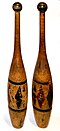 Indian clubs
 -
 Stone figure from 5th-7th Century CE
 -
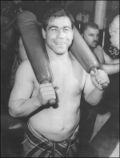 Pahlavan Takhti with meel
 -
 Dogu
Dogu -
 Indian club swinging team, St Paul's Young Men's Club, Ipswich, 1890s
 -
 Indian wrestler exercising, 1973
 -
 Carte de Visite of Sim D. Kehoe, late 1800s
 -
 Men working out at Zurkhaneh (House of Strength), Yazd, Central Iran


_-_Yazd_-_Central_Iran.jpg)
