Ionization energy: Difference between revisions
CSV import Tags: mobile edit mobile web edit |
CSV import Tags: mobile edit mobile web edit |
||
| Line 40: | Line 40: | ||
[[Category:Atomic Physics]] | [[Category:Atomic Physics]] | ||
{{Chemistry-stub}} | {{Chemistry-stub}} | ||
<gallery> | |||
File:First_Ionization_Energy_blocks.svg|Ionization energy | |||
File:Measurement_of_ionization_energy_of_atoms_-_schematic.svg|Ionization energy | |||
File:Ionization_energies_of_atoms_-_labeled_-_atomic_orbital_filling_indicated.svg|Ionization energy | |||
File:BerylliumVsBoronElectronConfiguration.jpg|Ionization energy | |||
File:NitrogenVsOxygenElectronConfiguration.jpg|Ionization energy | |||
File:NitrogenVsOxygenElectronConfigurationBoxAndArrows.jpg|Ionization energy | |||
File:ZincVsGalliumElectronConfiguration.jpg|Ionization energy | |||
File:RadiumVsActiniumElectronConfiguration.jpg|Ionization energy | |||
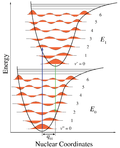
File:Franck-Condon-diagram.png|Ionization energy | |||
File:Electron_binding_energy_vs_Z.jpg|Ionization energy | |||
</gallery> | |||
Latest revision as of 12:12, 18 February 2025
Ionization energy (IE), also known as ionization potential, is the energy required to remove an electron from a neutral atom or molecule in the gaseous state. It is a fundamental property of atoms and molecules that has significant implications in chemistry, physics, and materials science. The ionization energy is measured in electron volts (eV) or kilojoules per mole (kJ/mol).
Overview[edit]
The concept of ionization energy is crucial in the study of atomic and molecular structures. It provides insights into the reactivity and chemical behavior of elements. The first ionization energy refers to the energy needed to remove the first electron from an atom, while the second ionization energy is the energy required to remove the second electron, and so on. Generally, the ionization energy increases as more electrons are removed, due to the increasing positive charge of the ion which more strongly attracts the remaining electrons.
Factors Affecting Ionization Energy[edit]
Several factors influence the ionization energy of an atom or molecule:
- Atomic Number: As the atomic number increases, the ionization energy generally increases because the electrons are held more tightly by the nucleus due to the greater nuclear charge.
- Electron Configuration: Atoms with a stable electron configuration (such as noble gases) have higher ionization energies because their electrons are more difficult to remove.
- Atomic Radius: Generally, the larger the atomic radius, the lower the ionization energy, because the outer electrons are further from the nucleus and are less strongly attracted to it.
- Shielding Effect: Inner electrons can shield outer electrons from the full charge of the nucleus, reducing the ionization energy for those outer electrons.
Periodic Trends[edit]
Ionization energy exhibits distinct trends within the Periodic Table:
- Across a Period: Ionization energy generally increases across a period from left to right. This is due to the increase in nuclear charge, which more strongly attracts electrons.
- Down a Group: Ionization energy generally decreases down a group. As the atomic radius increases, outer electrons are further from the nucleus and are more easily removed.
Applications[edit]
Ionization energy has various applications in different fields:
- In Chemistry, it helps in predicting the reactivity of elements and the formation of chemical bonds.
- In Physics, it is essential in the study of spectra and quantum mechanics.
- In Materials Science, understanding ionization energies is important for designing and characterizing new materials with specific electronic properties.
Measurement[edit]
Ionization energies are typically measured using techniques such as photoelectron spectroscopy, where photons are used to eject electrons from atoms or molecules, and the kinetic energy of the ejected electrons is analyzed.
See Also[edit]
References[edit]
<references/>

-
 Ionization energy
 -
 Ionization energy
 -
 Ionization energy
 -
 Ionization energy
 -
Ionization energy
-
Ionization energy
-
 Ionization energy
 -
Ionization energy
-
 Ionization energy
 -
 Ionization energy


