Peter Singer: Difference between revisions
CSV import Tags: mobile edit mobile web edit |
CSV import |
||
| Line 34: | Line 34: | ||
[[Category:University of Oxford alumni]] | [[Category:University of Oxford alumni]] | ||
{{Philosophy-bio-stub}} | {{Philosophy-bio-stub}} | ||
<gallery> | |||
File:Peter_Singer_2017_(cropped).jpg|Peter Singer in 2017 | |||
File:Singer1.jpg|Peter Singer | |||
File:Peter_Singer_-_Effective_Altruism_-Melb_Australia_Aug_2015.jpg|Peter Singer at Effective Altruism Melbourne, August 2015 | |||
File:Peter_Singer_no_Fronteiras_do_Pensamento_São_Paulo_2013_(9733467088).jpg|Peter Singer at Fronteiras do Pensamento São Paulo, 2013 | |||
File:Peter_Singer_2017-01_(cropped).jpg|Peter Singer in 2017 | |||
File:Peter_Singer.jpg|Peter Singer | |||
File:Peter_Singer_MIT_Veritas.jpg|Peter Singer at MIT Veritas | |||
File:Peter_Singer_no_Fronteiras_do_Pensamento_Porto_Alegre_(9620101528).jpg|Peter Singer at Fronteiras do Pensamento Porto Alegre | |||
</gallery> | |||
Latest revision as of 12:04, 18 February 2025
Peter Singer (July 6, 1946) is an Australian moral philosopher best known for his work in bioethics and his role in the animal rights movement. Singer's ideas have been influential in the world of philosophy, particularly in the field of applied ethics. His most notable contribution is the book Animal Liberation, published in 1975, which has been credited with launching the animal rights movement.
Early life and education[edit]
Singer was born in Melbourne, Australia, to Austrian Jewish parents who emigrated to Australia from Vienna in 1938, after Austria's annexation by Nazi Germany. He studied law, history, and philosophy at the University of Melbourne and later pursued graduate philosophy at the University of Oxford.
Career[edit]
Singer first gained recognition in the international academic community with the publication of Animal Liberation. The book argues in favor of veganism and against animal experimentation based on the principle of equal consideration of interests. Singer argues that animals have interests and these interests ought to be considered equally with the interests of humans.
In addition to his work on animal rights, Singer has also made significant contributions to the discussion of human rights, bioethics, and utilitarianism. He is known for his controversial views on issues like euthanasia, infanticide, and population ethics.
Singer has held professorships at several prestigious institutions, including the University of Oxford, New York University, and Princeton University, where he is currently the Ira W. DeCamp Professor of Bioethics at the University Center for Human Values.
Personal life[edit]
Singer is married to Renata Singer; they have three children. He is a vegan and advocates for animal rights not only in his academic work but also in his personal life.
See also[edit]
References[edit]
<references />
External links[edit]
This article is a Philosophy-related stub. You can help WikiMD by expanding it!
-
 Peter Singer in 2017
 -
 Peter Singer
 -
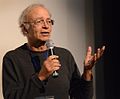 Peter Singer at Effective Altruism Melbourne, August 2015
 -
Peter Singer at Fronteiras do Pensamento São Paulo, 2013
-
Peter Singer in 2017
-
Peter Singer
-
Peter Singer at MIT Veritas
-
Peter Singer at Fronteiras do Pensamento Porto Alegre
.jpg)


.jpg)
.jpg)


.jpg)