Natufian culture: Difference between revisions
CSV import Tags: mobile edit mobile web edit |
CSV import |
||
| Line 21: | Line 21: | ||
{{Archaeology-stub}} | {{Archaeology-stub}} | ||
{{food-stub}} | {{food-stub}} | ||
<gallery> | |||
File:NatufianSpread.svg|Natufian culture | |||
File:Dorothy_Garrod_(centre)_1928_Natufian_culture_discovery.jpg|Dorothy Garrod (centre) 1928 Natufian culture discovery | |||
File:Climate_and_Post-Glacial_expansion_in_the_Near_East.jpg|Climate and Post-Glacial expansion in the Near East | |||
File:Dagon_Museum,_Mortars_from_Natufian_Culture,_Grinding_stones_from_Neolithic_pre-pottery_phase.JPG|Dagon Museum, Mortars from Natufian Culture, Grinding stones from Neolithic pre-pottery phase | |||
File:Şanlıurfa_Müzesi_barınak.jpg|Şanlıurfa Müzesi barınak | |||
File:Natufian-SupportingWall-Elwad.jpg|Natufian Supporting Wall Elwad | |||
File:Lovers_9000BC_british_museum.jpg|Lovers 9000BC British Museum | |||
File:El-Wad_Homo25_in_Rockefeller_Museum.jpg|El-Wad Homo25 in Rockefeller Museum | |||
File:Israel_Museum_Stone_Age.jpg|Israel Museum Stone Age | |||
File:Basalt_&_Limestone_Mortar_&_Pestle,_Natufian_Culture.jpg|Basalt & Limestone Mortar & Pestle, Natufian Culture | |||
File:Israel_Museum_Stone_Age_Artifact.jpg|Israel Museum Stone Age Artifact | |||
File:Basalt_Sharpening_Stones,_Natufian_Culture.jpg|Basalt Sharpening Stones, Natufian Culture | |||
</gallery> | |||
Revision as of 12:02, 18 February 2025
Natufian culture was an Epipaleolithic society that existed from 12,000 to 9,500 BC in the Levant, a region in the Eastern Mediterranean. The culture was unusual in that it supported a sedentary or semi-sedentary population even before the introduction of agriculture. The Natufian communities are possibly the ancestors of the builders of the first Neolithic settlements of the region, which may have been the earliest in the world. Some evidence suggests deliberate cultivation of cereals, specifically rye, by the Natufian culture, at the Tell Abu Hureyra site, the site for the earliest evidence of agriculture in the world. Generally, though, Natufians made use of wild cereals. Animals hunted included gazelles.
Origins
The Natufian culture was discovered by Dorothy Garrod during her excavations of Shuqba cave in the Judean Desert. The culture is named after the Natuf site, located in Mount Carmel, which was the first to be thoroughly excavated from a layer containing Natufian remains.
Settlements
Natufian culture is characterized by the establishment of permanent settlements, which were often larger than those of earlier cultures. They are considered to be among the earliest known builders of permanent houses. The people of the Natufian culture were also among the first to bury their dead in formal cemeteries, a practice that had previously been sporadic.
Economy
The Natufian economy, based on the exploitation of wild plants and animals, was unusually diverse for the Paleolithic. The degree of Natufian sedentism is a subject of debate, with some seeing the society as largely sedentary and others viewing it as semi-nomadic.
Art
The Natufian had a diversified and complex art, including stone and bone tools, jewelry, and statuettes of animals and humans. There was a rich variety of types of graves and grave goods.
Legacy
The Natufian culture left a lasting impact on the subsequent cultures of the region, including the Neolithic cultures that followed it and eventually gave rise to the civilizations of the Fertile Crescent.


-
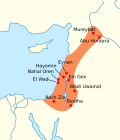 Natufian culture
 -
 Dorothy Garrod (centre) 1928 Natufian culture discovery
 -
 Climate and Post-Glacial expansion in the Near East
 -
 Dagon Museum, Mortars from Natufian Culture, Grinding stones from Neolithic pre-pottery phase
 -
 Şanlıurfa Müzesi barınak
 -
 Natufian Supporting Wall Elwad
 -
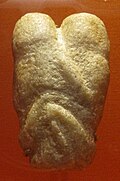 Lovers 9000BC British Museum
 -
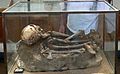 El-Wad Homo25 in Rockefeller Museum
 -
 Israel Museum Stone Age
 -
 Basalt & Limestone Mortar & Pestle, Natufian Culture
 -
 Israel Museum Stone Age Artifact
 -
 Basalt Sharpening Stones, Natufian Culture

_1928_Natufian_culture_discovery.jpg)


