Nestor Makhno: Difference between revisions
CSV import |
CSV import |
||
| Line 41: | Line 41: | ||
[[Category:1934 deaths]] | [[Category:1934 deaths]] | ||
{{Anarchism-stub}} | {{Anarchism-stub}} | ||
<gallery> | |||
File:1921._Нестор_Махно_в_лагере_для_перемещенных_лиц_в_Румынии.jpg|Nestor Makhno | |||
File:%D0%97%D0%B0%D0%BF%D0%B8%D1%81_%D0%B2_%D0%BC%D0%B5%D1%82%D1%80%D0%B8%D1%87%D0%BD%D1%96%D0%B9_%D0%BA%D0%BD%D0%B8%D0%B7%D1%96_%D0%BF%D1%80%D0%BE_%D0%BD%D0%B0%D1%80%D0%BE%D0%B4%D0%B6%D0%B5%D0%BD%D0%BD%D1%8F_%D0%9D%D0%B5%D1%81%D1%82%D0%BE%D1%80%D0%B0_%D0%9C%D0%B0%D1%85%D0%BD%D0%BE.jpg|Nestor Makhno | |||
File:Butyrka_prison_ed.jpg|Nestor Makhno | |||
File:Makhno's_journey_to_Moscow_(1918).svg|Nestor Makhno | |||
File:Makhno_group.jpg|Nestor Makhno | |||
File:Makhno-1919.jpg|Nestor Makhno | |||
File:Makhnovia.svg|Nestor Makhno | |||
File:Tachanka_in_Huliaipole_Museum.jpg|Nestor Makhno | |||
File:Нестор_Махно_с_дочерью,_Париж.jpg|Nestor Makhno | |||
File:Ot_Vinta!.JPG|Nestor Makhno | |||
</gallery> | |||
Latest revision as of 11:58, 18 February 2025
Nestor Ivanovich Makhno (October 26, 1888 – July 25, 1934) was a Ukrainian anarchist revolutionary and the leader of the Makhnovshchina, a guerrilla campaign which operated in the Ukraine during the Russian Civil War (1917–1923). Makhno is known for his role in establishing the Free Territory, an attempt at anarchist society, and for his leadership in guerrilla warfare against both White and Red forces.
Early Life[edit]
Born in Huliaipole, in the Russian Empire, Makhno was the youngest of five children in a peasant family. He received a basic education before working in a foundry. Makhno became involved in political activism and joined the local anarchist group in Huliaipole.
Revolutionary Activities[edit]
During the Russian Revolution of 1917, Makhno emerged as a prominent local anarchist leader. By 1918, he had organized a peasant militia, known as the Black Army, which fought against various opposing forces, including the Austro-Hungarian Empire, the White Army, and later the Red Army. Makhno's forces were crucial in defending the region's attempt at anarchist communism, known as the Free Territory, which sought to abolish traditional state functions and promote self-management and communal resources.
Conflict with the Bolsheviks[edit]
Initially, Makhno cooperated with the Bolsheviks against the common White threat. However, ideological and strategic differences soon emerged. The Bolsheviks, under Vladimir Lenin's leadership, aimed to centralize power and establish a communist state, contrary to Makhno's vision of decentralized, stateless socialism. By 1920, this rift led to open conflict, with the Red Army eventually defeating Makhno's forces in 1921.
Exile and Death[edit]
After his defeat, Makhno fled to Romania, and later moved to Poland and then Paris, France, where he lived in exile until his death in 1934. He continued to be active in the anarchist movement during his exile and wrote several pieces on the anarchist cause and his experiences.
Legacy[edit]
Nestor Makhno remains a controversial and complex figure in Ukrainian history. Revered by some as a champion of the oppressed peasantry and a pioneer of anarchist practice, he is also criticized for the violent tactics his forces employed. His life and work continue to be studied in the contexts of both Ukrainian national history and the global anarchist movement.
See Also[edit]

-
 Nestor Makhno
 -
 Nestor Makhno
 -
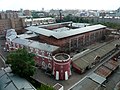 Nestor Makhno
 -
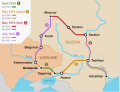 Nestor Makhno
 -
 Nestor Makhno
 -
 Nestor Makhno
 -
 Nestor Makhno
 -
 Nestor Makhno
 -
 Nestor Makhno
 -
 Nestor Makhno


.svg)


