Asteroid belt: Difference between revisions
CSV import Tags: mobile edit mobile web edit |
CSV import |
||
| Line 32: | Line 32: | ||
[[Category:Solar System]] | [[Category:Solar System]] | ||
{{solar-system-stub}} | {{solar-system-stub}} | ||
<gallery> | |||
File:InnerSolarSystem-en.png|Asteroid belt | |||
File:Ceres-Vesta-Eros_compared_to_Pluto-Charon.jpg|Asteroid belt | |||
File:JKepler.jpg|Asteroid belt | |||
File:Costanzo_Angelini,_L'astronomo_Piazzi_1825_ca.jpg|Asteroid belt | |||
File:951_Gaspra.jpg|Asteroid belt | |||
File:Main_belt_i_vs_a.png|Asteroid belt | |||
File:Vesta_from_Dawn,_July_18.jpg|Asteroid belt | |||
File:Main_belt_asteroid_size_distribution.svg|Asteroid belt | |||
File:Asteroid_populations_by_orbital_distance.svg|Asteroid belt | |||
File:AllendeMeteorite.jpg|Asteroid belt | |||
File:Hubble_views_extraordinary_multi-tailed_asteroid_P2013_P5.jpg|Asteroid belt | |||
File:Main_belt_e_vs_a.png|Asteroid belt | |||
</gallery> | |||
Latest revision as of 11:53, 18 February 2025
Asteroid Belt
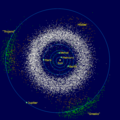
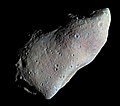
The Asteroid Belt is a region of space located between the orbits of the planets Mars and Jupiter. It is populated by numerous irregularly shaped bodies called asteroids or minor planets.
Overview[edit]
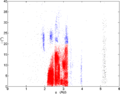
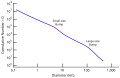
The Asteroid Belt is home to a large number of asteroids, which are remnants from the early solar system. These objects range in size from small boulders to objects nearly 1000 kilometers in diameter. The total mass of the Asteroid Belt is estimated to be about 4% of the mass of the Moon.
Formation[edit]
The Asteroid Belt is thought to have formed from the protoplanetary disk that surrounded the young Sun about 4.6 billion years ago. The process of accretion led to the formation of many small bodies, which collided and merged to form larger bodies. However, the strong gravitational influence of nearby Jupiter prevented these bodies from coalescing into a planet.
Composition[edit]
Asteroids in the Asteroid Belt are composed of a variety of materials, including rock, metal, and carbonaceous compounds. The composition of individual asteroids can be determined by studying their spectral class.
Exploration[edit]
Several spacecraft have visited the Asteroid Belt, including Pioneer 10, Galileo, and Dawn. These missions have provided valuable information about the composition, structure, and history of the asteroids.
See also[edit]
References[edit]
<references group="" responsive="1"></references>
This solar system related article is a stub. You can help WikiMD by expanding it.
-
 Asteroid belt
 -
 Asteroid belt
 -
 Asteroid belt
 -
 Asteroid belt
 -
 Asteroid belt
 -
 Asteroid belt
 -
 Asteroid belt
 -
 Asteroid belt
 -
 Asteroid belt
 -
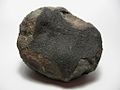 Asteroid belt
 -
 Asteroid belt
 -
 Asteroid belt


