Tusk shell: Difference between revisions
CSV import |
CSV import |
||
| Line 43: | Line 43: | ||
[[Category:Scaphopoda]] | [[Category:Scaphopoda]] | ||
[[Category:Molluscs]] | [[Category:Molluscs]] | ||
<gallery> | |||
File:Scaphopoda_(10.3897-zookeys.707.13042)_Figure_23.jpg|Tusk_shell | |||
File:Calliodentalium_semitracheatum_(MNHN-IM-2012-13993).jpeg|Tusk_shell | |||
File:05898_Grand_Canyon_Mollusca_Fossils_(4739033749).jpg|Tusk_shell | |||
File:Scaphopoda.svg|Tusk_shell | |||
File:Necklace_PRE.2009.0.238.1-a.jpg|Tusk_shell | |||
File:Necklace_PRE.2009.0.238.1-IMG_1851.jpg|Tusk_shell | |||
File:Necklace_PRE.2009.0.238.1-IMG_1992.jpg|Tusk_shell | |||
File:Necklace_PRE.2009.0.238.1-IMG_2001.jpg|Tusk_shell | |||
</gallery> | |||
Latest revision as of 11:51, 18 February 2025
Tusk Shell[edit]
_Figure_23.jpg)
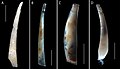
Tusk shells, also known as Scaphopoda, are a class of marine mollusks characterized by their elongated, tubular shells that resemble miniature elephant tusks. These shells are open at both ends, allowing the animal to burrow into the substrate with its foot while extending its feeding tentacles into the water.
Description[edit]
.jpeg)
Tusk shells are typically small, ranging from a few millimeters to several centimeters in length. The shell is conical and slightly curved, with a smooth or ribbed surface. The animal's body is elongated to fit within the shell, with a foot adapted for digging and a set of tentacles called captacula used for capturing food particles.
Habitat and Distribution[edit]
Tusk shells are found in marine environments worldwide, from shallow coastal waters to deep ocean floors. They prefer sandy or muddy substrates where they can burrow and feed on detritus and microorganisms.
Feeding and Behavior[edit]
Scaphopods are detritivores, feeding primarily on microscopic organisms and organic particles. They use their captacula to capture food, which is then transported to the mouth. The captacula are highly sensitive and can detect chemical signals in the water, aiding in the location of food.
Fossil Record[edit]
.jpg)
The fossil record of tusk shells dates back to the Cambrian period, making them one of the oldest known groups of mollusks. Fossilized scaphopods provide valuable insights into the evolution of mollusks and the environmental conditions of ancient marine ecosystems.
Human Use[edit]

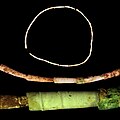
Tusk shells have been used by humans for decorative purposes, particularly in jewelry. Their unique shape and natural luster make them popular in the creation of necklaces and other adornments.
Related Pages[edit]
References[edit]
-
 Tusk_shell
 -
 Tusk_shell
 -
 Tusk_shell
 -
 Tusk_shell
 -
 Tusk_shell
 -
 Tusk_shell
 -
 Tusk_shell
 -
 Tusk_shell


