Peter Pan: Difference between revisions
CSV import |
CSV import |
||
| Line 26: | Line 26: | ||
[[Category:Peter Pan]] | [[Category:Peter Pan]] | ||
{{literature-stub}} | {{literature-stub}} | ||
<gallery> | |||
File:Peter_pan_1911_pipes_(cropped).jpg|Peter Pan | |||
File:Peter_Pan,_by_Oliver_Herford,_1907.png|Peter Pan | |||
File:Peter_Pan_1915_cover.jpg|Peter Pan | |||
File:Peter_Pan_disney.jpg|Peter Pan | |||
File:The_Paradise_of_Peter_Pan,_print_of_painting_by_Edward_Mason_Eggleston,_1932.jpg|Peter Pan | |||
File:Peter_Pan_statue_in_Kensington_Gardens_in_the_City_of_Westminster_in_London,_spring_2013_(12).JPG|Peter Pan | |||
File:Kirriemuir,_Peter_Pan_Statue.jpg|Peter Pan | |||
File:Statue_of_Peter_Pan_and_Tinkerbell_in_Dunedin_Botanic_Gardens,_Dunedin,_New_Zealand.jpg|Peter Pan | |||
File:Peter_Pan_statue_by_Diarmuid_Byron_O'Connor.JPG|Peter Pan | |||
File:Carl_Schurz_Park_Peter_Pan_statue.jpg|Peter Pan | |||
</gallery> | |||
Latest revision as of 11:50, 18 February 2025
Peter Pan is a fictional character created by Scottish novelist and playwright J.M. Barrie. A free-spirited and mischievous young boy who can fly and never grows up, Peter Pan spends his never-ending childhood having adventures on the mythical island of Neverland as the leader of the Lost Boys, interacting with fairies, pirates, mermaids, Native Americans, and occasionally ordinary children from the world outside Neverland.
Creation and history[edit]
Peter Pan first appeared as a character in Barrie's The Little White Bird (1902), a semi-autobiographical novel. In 1904, he returned in the stage play Peter Pan, or The Boy Who Wouldn't Grow Up, which was later adapted into the 1911 novel Peter and Wendy. The character's mythos has been expanded and explored in numerous adaptations and sequels in various media, including books, films, and television series.
Character[edit]
Peter Pan is depicted as a young boy who never ages, a condition he describes as "the curse of his existence". He is a skilled swordsman, rivalling even Captain Hook, but is also incredibly cocky and arrogant. His ability to fly is explained as being due to his happy thoughts and a special kind of fairy dust provided by Tinker Bell, a fairy who is his close companion.
Themes and analysis[edit]
Peter Pan is a complex figure with multiple interpretations. He is often seen as a symbol of eternal childhood and innocence, but also embodies the fear of adulthood and responsibility. His relationship with Wendy Darling, who represents the cusp of adolescence and the responsibilities of adulthood, is a central theme in the Peter Pan stories.
Adaptations[edit]
Peter Pan has been adapted into numerous forms, including film, television, and musical theatre. Notable adaptations include the 1953 animated film by Walt Disney Studios, the 2003 live-action film by Universal Pictures, and the 1954 Broadway musical.
Legacy[edit]
Peter Pan has had a significant impact on popular culture, inspiring numerous works and becoming a part of the public consciousness. The character has been used in a variety of contexts, from psychological analysis to commercial advertising.

This article is a literature-related stub. You can help WikiMD by expanding it!
-
 Peter Pan
 -
 Peter Pan
 -
 Peter Pan
 -
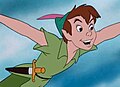 Peter Pan
 -
 Peter Pan
 -
 Peter Pan
 -
 Peter Pan
 -
 Peter Pan
 -
 Peter Pan
 -
 Peter Pan
.jpg)


.JPG)


