Electronegativity: Difference between revisions
CSV import Tags: mobile edit mobile web edit |
CSV import |
||
| Line 34: | Line 34: | ||
{{stub}} | {{stub}} | ||
<gallery> | |||
File:Electrostatic_Potential.jpg|Electrostatic potential map | |||
File:Pauling_and_Mullikan_electronegativities.png|Pauling and Mullikan electronegativities | |||
File:Pauling_and_Allred-Rochow_electronegativities.png|Pauling and Allred-Rochow electronegativities | |||
File:Pauling_and_Sanderson_electronegativities.png|Pauling and Sanderson electronegativities | |||
File:Pauling_and_Allen_electronegativities.png|Pauling and Allen electronegativities | |||
File:Sn-119_isomer_shifts_in_hexahalostannates.png|Sn-119 isomer shifts in hexahalostannates | |||
File:Periodic_variation_of_Pauling_electronegativities.svg|Periodic variation of Pauling electronegativities | |||
</gallery> | |||
Latest revision as of 11:46, 18 February 2025
Electronegativity is a measure of the tendency of an atom to attract a bonding pair of electrons. The Pauling scale is the most commonly used. Fluorine (the most electronegative element) is assigned a value of 4.0, and values range down to cesium and francium which are the least electronegative at 0.7.
Overview[edit]
Electronegativity is used to predict whether a bond between atoms will be ionic or covalent. It can also be used to predict if the resulting molecule will be polar or nonpolar. This concept is useful in understanding the distribution of electron density in a molecule.
Pauling Scale[edit]
The Pauling Scale is the most commonly used electronegativity scale. It was developed by Linus Pauling and is based on bond energies. The most electronegative element, fluorine, is assigned a value of 4.0. The least electronegative elements, cesium and francium, have a value of 0.7.
Factors Affecting Electronegativity[edit]
Several factors affect the electronegativity of an atom. These include the atom's atomic number, the distance between the atom's nucleus and its valence electrons (the atomic radius), and the number of places in the atom's outermost electron shell that are occupied by electrons (the number of valence electrons).
Applications of Electronegativity[edit]
Electronegativity is a fundamental concept in chemistry, and it has wide applications. It is used to predict the type of bond that will form between two atoms. It is also used to predict the polarity of a molecule, which is important in understanding its physical and chemical properties.
See Also[edit]
References[edit]
<references />
 | |
|---|---|
 |
 |
-
 Electrostatic potential map
 -
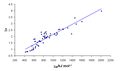 Pauling and Mullikan electronegativities
 -
 Pauling and Allred-Rochow electronegativities
 -
 Pauling and Sanderson electronegativities
 -
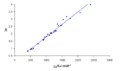 Pauling and Allen electronegativities
 -
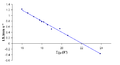 Sn-119 isomer shifts in hexahalostannates
 -
 Periodic variation of Pauling electronegativities


