Tsetse fly: Difference between revisions
CSV import |
CSV import |
||
| Line 53: | Line 53: | ||
[[Category:Insects of Africa]] | [[Category:Insects of Africa]] | ||
[[Category:Vectors of human pathogens]] | [[Category:Vectors of human pathogens]] | ||
<gallery> | |||
File:Glossina-morsitans.jpg|Tsetse fly | |||
File:tsetse_head-proboscis.jpeg|Tsetse fly | |||
File:tsetse_foldedWings.jpeg|Tsetse fly | |||
File:tsetse_hatchetCell.jpeg|Tsetse fly | |||
File:tsetse_aristaHairs_labeled.jpeg|Tsetse fly | |||
File:Gándulas_de_la_leche_de_Glossina_.gif|Tsetse fly | |||
File:Dipteran-fly-structure.jpg|Tsetse fly | |||
File:glossina_palpalis_morsitans.jpg|Tsetse fly | |||
File:Trypanosoma_sp._PHIL_613_lores.jpg|Tsetse fly | |||
File:Tsetse-BKF-3.jpg|Tsetse fly | |||
File:TsetseTrap.jpg|Tsetse fly | |||
File:Masai_Giraffe,_Serengeti_National_Park,_Tanzania_(2010).jpg|Tsetse fly | |||
</gallery> | |||
Revision as of 11:46, 18 February 2025
Tsetse Fly
The tsetse fly is a large biting fly belonging to the genus Glossina in the family Glossinidae. These flies are found in tropical Africa and are known for their role in transmitting the parasites that cause African trypanosomiasis, or sleeping sickness, in humans and nagana in animals.
Description
Tsetse flies are robust flies with a length of 6 to 14 mm. They have a characteristic proboscis, which is a long, forward-projecting structure used for feeding on the blood of vertebrate hosts. The wings of tsetse flies are held in a scissor-like position over the abdomen when at rest. The flies are distinguished by a hatchet-shaped cell in the wing, known as the "hatchet cell".
Life Cycle
Tsetse flies undergo a unique reproductive process among insects. Female tsetse flies give birth to live larvae, which are deposited in the soil. The larvae quickly burrow and pupate, emerging as adult flies after several weeks. This viviparous reproduction is supported by specialized milk glands in the female fly.
Habitat and Distribution
Tsetse flies inhabit a variety of environments across sub-Saharan Africa, including savannas, woodlands, and riverine areas. Their distribution is closely linked to the presence of suitable hosts and environmental conditions that support their life cycle.
Disease Transmission
Tsetse flies are vectors for the Trypanosoma parasites, which cause sleeping sickness in humans and nagana in animals. The disease is transmitted when an infected fly bites a host, injecting the parasites into the bloodstream. Control of tsetse populations is crucial in managing the spread of these diseases.
Control Measures
Efforts to control tsetse fly populations include the use of insecticide-treated traps and targets, sterile insect technique, and habitat modification. These methods aim to reduce the population of flies and interrupt the transmission cycle of the trypanosome parasites.
Related Pages
References
- Leak, S. G. A. (1999). Tsetse Biology and Ecology: Their Role in the Epidemiology and Control of Trypanosomiasis. CABI Publishing.
- Jordan, A. M. (1993). Tsetse Flies (Glossinidae). In: Lane, R. P., & Crosskey, R. W. (Eds.), Medical Insects and Arachnids. Springer.
Gallery
-
 Glossina morsitans
 -
 Tsetse fly head and proboscis
 -
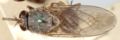 Tsetse fly with folded wings
 -
 Hatchet cell in tsetse fly wing
 -
 Arista hairs on tsetse fly
 -
 Structure of a dipteran fly
 -
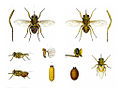 Glossina palpalis morsitans
 -
Trypanosoma sp.
-
Tsetse fly in Burkina Faso
-
Tsetse fly trap
-
Habitat of tsetse flies
-
Tsetse fly in Burkina Faso


-
Tsetse fly
-
Tsetse fly
-
Tsetse fly
-
Tsetse fly
-
Tsetse fly
-
Tsetse fly
-
Tsetse fly
-
Tsetse fly
-
Tsetse fly
-
Tsetse fly
-
Tsetse fly
-
Tsetse fly


.jpg)

