Indigo dye: Difference between revisions
CSV import |
CSV import |
||
| Line 32: | Line 32: | ||
{{Dye-stub}} | {{Dye-stub}} | ||
{{food-stub}} | {{food-stub}} | ||
<gallery> | |||
File:Indigo_cake.jpg|Indigo dye | |||
File:Indigo_plant_extract_sample.jpg|Indigo dye | |||
File:Indigo-Historische_Farbstoffsammlung.jpg|Indigo dye | |||
File:Meisje_met_de_parel.jpg|Indigo dye | |||
File:Isatis_tinctoria02.JPG|Indigo dye | |||
File:Schreber_woad_mill_1752.JPG|Indigo dye | |||
File:The_Hunt_of_the_Unicorn_Tapestry_1.jpg|Indigo dye | |||
File:Indigofera_tinctoria1.jpg|Indigo dye | |||
File:Indigo-Historische_Farbstoffsammlung.jpg|Indigo dye | |||
File:Indian_indigo_dye_lump.jpg|Indigo dye | |||
File:Ridpath's_history_of_the_world;_being_an_account_of_the_ethnic_origin,_primitive_estate,_early_migrations,_social_conditions_and_present_promise_of_the_principal_families_of_men_(1897)_(14597001160).jpg|Indigo dye | |||
File:Touaregs_at_the_Festival_au_Desert_near_Timbuktu,_Mali_2012.jpg|Indigo dye | |||
</gallery> | |||
Latest revision as of 11:44, 18 February 2025
Indigo dye is a deep blue colorant that has been used for thousands of years to dye fabric. It is derived from the plant Indigofera tinctoria, also known as true indigo, but can also be synthesized in a laboratory.
History[edit]
The use of indigo dye dates back to the Neolithic period. It was a significant item of trade in the Silk Road and was used in many cultures around the world. The ancient Greeks and Romans used indigo as a luxury product, while in India, it was a major part of the dyeing industry.
Production[edit]
The production of indigo dye involves a complex process that requires the leaves of the Indigofera tinctoria plant to be soaked in water and fermented in order to convert the natural glycoside indican present in the plant to indoxyl. This substance is then oxidized to produce indigo.
Uses[edit]
Indigo dye is most commonly used in the dyeing of denim for blue jeans. It is also used in many traditional forms of art and craft such as batik and shibori.
Synthetic Indigo[edit]
In the late 19th century, German chemist Adolf von Baeyer developed a method to synthesize indigo, reducing reliance on plant-based sources. Today, most indigo dye is synthetic.
Environmental Impact[edit]
The production of indigo dye, particularly synthetic indigo, has been associated with significant environmental impact due to the use of harmful chemicals in the dyeing process. This has led to increased interest in sustainable alternatives.
See Also[edit]


-
 Indigo dye
 -
 Indigo dye
 -
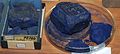 Indigo dye
 -
 Indigo dye
 -
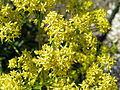 Indigo dye
 -
 Indigo dye
 -
 Indigo dye
 -
 Indigo dye
 -
Indigo dye
-
 Indigo dye
 -
 Indigo dye
 -
 Indigo dye


_(14597001160).jpg)

