Spiral: Difference between revisions
CSV import |
CSV import |
||
| Line 33: | Line 33: | ||
{{stub}} | {{stub}} | ||
<gallery caption="Spiral"> | |||
File:NautilusCutawayLogarithmicSpiral.jpg|Nautilus cutaway showing a logarithmic spiral | |||
File:Six_types_of_spirals.png|Six types of spirals | |||
File:Archimedean_spiral.svg|Archimedean spiral | |||
File:Hyperspiral.svg|Hyperspiral | |||
File:Fermat's_spiral.svg|Fermat's spiral | |||
File:Lituus.svg|Lituus | |||
File:Logarithmic_Spiral_Pylab.svg|Logarithmic spiral | |||
File:Cornu_Spiral.svg|Cornu spiral | |||
File:Spiral_of_Theodorus.svg|Spiral of Theodorus | |||
File:Fibonacci_spiral.svg|Fibonacci spiral | |||
File:Archimedean-involute-circle-spirals-comparison.svg|Comparison of Archimedean, involute, and circle spirals | |||
File:Schraublinie-hyp-spirale.svg|Schraublinie hyp-spirale | |||
</gallery> | |||
Revision as of 11:41, 18 February 2025
Spiral
A Spiral is a curve which emanates from a point, moving farther away as it revolves around the point. Spirals are found in nature, but also in various aspects of mathematics, physics, and art.
Mathematical description
In mathematics, a spiral is a curve which emanates from an origin and moves farther away (or closer) as it revolves around the point. Two important types of spirals are the Archimedean spiral and the logarithmic spiral.
Archimedean spiral
The Archimedean spiral is a spiral named after the 3rd-century BC Greek mathematician Archimedes. It is the locus of points corresponding to the locations over time of a point moving away from a fixed point with a constant speed along a line which rotates with constant angular velocity.
Logarithmic spiral
The logarithmic spiral is a spiral whose polar coordinates (r, θ) satisfy the equation, where e is the base of natural logarithms, a is a positive real number, and b is a real number. This spiral gets wider (or stays the same or gets narrower) for every full rotation depending on whether b is greater than, equal to, or less than 1.
Spirals in nature
Spirals are prevalent in nature, appearing in phenomena such as galaxies, hurricanes, and sunflowers. The Fibonacci sequence is a mathematical concept that is often associated with spirals in nature.
Spirals in art and architecture
Spirals have been used in art and architecture throughout history, from ancient cultures to modern times. They can be seen in the designs of pottery, mosaics, and architecture, among other things.
See also
 | |
|---|---|
 |
 |
- Spiral
-
 Nautilus cutaway showing a logarithmic spiral
 -
 Six types of spirals
 -
 Archimedean spiral
 -
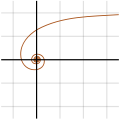 Hyperspiral
 -
 Fermat's spiral
 -
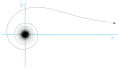 Lituus
 -
 Logarithmic spiral
 -
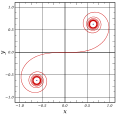 Cornu spiral
 -
 Spiral of Theodorus
 -
 Fibonacci spiral
 -
 Comparison of Archimedean, involute, and circle spirals
 -
 Schraublinie hyp-spirale


