Western Europe: Difference between revisions
CSV import Tags: mobile edit mobile web edit |
CSV import Tags: mobile edit mobile web edit |
||
| Line 28: | Line 28: | ||
{{Europe-stub}} | {{Europe-stub}} | ||
{{food-stub}} | {{food-stub}} | ||
<gallery> | |||
File:Expansion_of_christianity.jpg|Expansion of Christianity | |||
File:Europe-blocs-49-89x4.svg|Europe Blocs 1949-1989 | |||
File:Western_European_Union_(1995-2011).svg|Western European Union (1995-2011) | |||
File:Europe_subregion_map_UN_geoscheme.svg|Europe Subregion Map UN Geoscheme | |||
File:Europe_subregion_map_world_factbook.svg|Europe Subregion Map World Factbook | |||
File:European_Regions_EuroVoc.png|European Regions EuroVoc | |||
File:UN_WEOG_members.svg|UN WEOG Members | |||
File:Europe_Köppen_Map.png|Europe Köppen Map | |||
</gallery> | |||
Latest revision as of 11:37, 18 February 2025
Western Europe is a region of the European continent that includes countries such as France, Germany, United Kingdom, Italy, Spain, Portugal, Belgium, Netherlands, Luxembourg, Ireland, Switzerland, Austria, Monaco, Liechtenstein, Andorra, San Marino, and the Vatican City. The region is defined by a number of factors including geography, history, culture, and economics.
Geography[edit]
Western Europe is located in the western part of the European continent. It is bounded by the Atlantic Ocean to the west, the Arctic Ocean to the north, the Mediterranean Sea to the south, and to the east by the countries of Central Europe and Eastern Europe. The region includes several major peninsulas such as the Iberian Peninsula, the Italian Peninsula, and the Jutland Peninsula. It also includes several major islands such as Great Britain, Ireland, and Iceland.
History[edit]
The history of Western Europe is marked by several key periods including the Roman Empire, the Middle Ages, the Renaissance, the Industrial Revolution, and the two World Wars. The region has been the birthplace of many significant cultural, scientific, and political developments that have shaped the world.
Culture[edit]
Western Europe is known for its rich and diverse culture. It is the birthplace of many of the world's most famous artists, writers, musicians, and philosophers. The region is also known for its architectural heritage, with many cities boasting a mix of ancient, medieval, and modern buildings.
Economy[edit]
The economy of Western Europe is one of the most developed in the world. The region is home to several of the world's largest economies including Germany, the United Kingdom, and France. It is also home to many multinational corporations and financial institutions.
Politics[edit]
Western Europe is characterized by a high degree of political integration. Many of the countries in the region are members of the European Union, a political and economic union that promotes cooperation and integration among its member states.
See also[edit]


-
Expansion of Christianity
-
Europe Blocs 1949-1989
-
Western European Union (1995-2011)
-
Europe Subregion Map UN Geoscheme
-
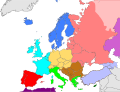 Europe Subregion Map World Factbook
 -
European Regions EuroVoc
-
UN WEOG Members
-
Europe Köppen Map


.svg)


