Arthur Griffith: Difference between revisions
CSV import |
CSV import |
||
| Line 41: | Line 41: | ||
[[Category:Aquaculture]] | [[Category:Aquaculture]] | ||
[[Category:Salmon]] | [[Category:Salmon]] | ||
<gallery> | |||
File:Arthur_Griffith.jpg|Arthur Griffith | |||
File:Arthur_Griffith_071022.jpg|Arthur Griffith | |||
File:Picture_of_Michael_Collins_and_Arthur_Griffith.jpg|Michael Collins and Arthur Griffith | |||
File:The_peacemakers-_George_Gavan_Duffy,_Erskine_Childers,_Robert_Barton_and_Arthur_Griffith_in_a_group_(28455606301).jpg|The peacemakers: George Gavan Duffy, Erskine Childers, Robert Barton, and Arthur Griffith | |||
File:Arthur_Griffith_Grave.jpg|Arthur Griffith's Grave | |||
File:Michael_Collins_Risteard_Mulcahy_Glasnevin_Cemetery_at_the_funeral_of_Arthur_Griffith.jpg|Michael Collins and Risteard Mulcahy at the funeral of Arthur Griffith | |||
</gallery> | |||
Latest revision as of 11:36, 18 February 2025
Genetically modified Atlantic salmon
AquAdvantage salmon is a genetically modified (GM) Atlantic salmon (Salmo salar) developed by AquaBounty Technologies. It is designed to grow faster than its non-GM counterparts, reaching market size in a shorter period of time. This is achieved by incorporating a growth hormone-regulating gene from the Chinook salmon (Oncorhynchus tshawytscha) and a promoter from the ocean pout (Zoarces americanus).
Development[edit]
The development of AquAdvantage salmon began in the late 1980s when researchers sought to enhance the growth rate of farmed salmon. By inserting a growth hormone gene from the Chinook salmon, which naturally grows larger and faster, and using a promoter from the ocean pout, scientists were able to create a salmon that grows year-round instead of only during the warmer months.
Genetic Modification[edit]
The genetic modification involves the insertion of a transgene construct into the salmon's genome. This construct includes:
- A growth hormone gene from the Chinook salmon.
- A promoter sequence from the ocean pout, which allows the growth hormone to be expressed continuously.
This modification enables the AquAdvantage salmon to grow to market size in about half the time it takes for conventional salmon, typically 16 to 18 months compared to 28 to 36 months.
Regulatory Approval[edit]
AquAdvantage salmon was the first genetically modified animal to be approved for human consumption. The United States Food and Drug Administration (FDA) approved it in November 2015 after a thorough review process that lasted several years. The FDA concluded that the fish is safe to eat and that the genetic modification is safe for the fish itself.
In Canada, the salmon was approved for sale in 2016 by Health Canada and the Canadian Food Inspection Agency, which also determined that it is safe for consumption and poses no risk to the environment when raised in contained facilities.
Environmental and Ethical Considerations[edit]
The production of AquAdvantage salmon has raised several environmental and ethical concerns. Critics argue that the escape of GM salmon into the wild could threaten natural salmon populations through competition and interbreeding. To mitigate these risks, AquaBounty raises the salmon in land-based, contained facilities and produces only sterile females to prevent reproduction.
Ethical concerns also focus on the welfare of the genetically modified fish and the broader implications of genetic engineering in animals. Proponents argue that AquAdvantage salmon can help meet the growing demand for protein while reducing the environmental impact of traditional salmon farming.
Commercial Production[edit]
AquaBounty Technologies operates facilities in Prince Edward Island, Canada, and Indiana, USA, where they produce AquAdvantage salmon. The company emphasizes the sustainability of its operations, highlighting reduced feed conversion ratios and lower carbon footprints compared to conventional salmon farming.
Related pages[edit]
Gallery[edit]
-
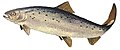 Atlantic salmon

-
Arthur Griffith
-
Arthur Griffith
-
Michael Collins and Arthur Griffith
-
The peacemakers: George Gavan Duffy, Erskine Childers, Robert Barton, and Arthur Griffith
-
Arthur Griffith's Grave
-
Michael Collins and Risteard Mulcahy at the funeral of Arthur Griffith


.jpg)

