Pacific oyster: Difference between revisions
CSV import |
CSV import |
||
| Line 25: | Line 25: | ||
{{Bivalve-stub}} | {{Bivalve-stub}} | ||
{{food-stub}} | {{food-stub}} | ||
<gallery> | |||
File:Crassostrea_gigas_p1040847.jpg|Pacific oyster | |||
File:Adult-Pacific-Oyster-(Crassostrea-gigas)-May-Have-Light-Sensitivity-pone.0140149.s001.ogv|Adult Pacific Oyster (Crassostrea gigas) May Have Light Sensitivity | |||
File:Crassostrea_gigas_02.jpg|Pacific oyster | |||
File:Crassostrea_gigas_03.jpg|Pacific oyster | |||
File:Pacific_oysters.jpg|Pacific oysters | |||
File:Oyster_pits_in_Yerseke_Netherlands_01.jpg|Oyster pits in Yerseke, Netherlands | |||
File:Pacific_cupped_oyster_total_production_thousand_tonnes_1950-2022.svg|Pacific cupped oyster total production (thousand tonnes) 1950-2022 | |||
</gallery> | |||
Latest revision as of 11:36, 18 February 2025
Pacific Oyster (Crassostrea gigas) is a species of oyster native to the Pacific coast of Asia. It has become an important part of the aquaculture industry worldwide, particularly in North America, Europe, and Australia.
Description[edit]
The Pacific oyster is a bivalve mollusk with a rough, irregularly shaped shell. The shell's interior is smooth and usually white or off-white. Adult Pacific oysters can reach a size of up to 400 millimeters.
Habitat and Distribution[edit]
Pacific oysters are native to the Pacific coast of Asia, from Japan to the Bering Sea. However, they have been introduced to other parts of the world for aquaculture purposes. They are now found in North America, Europe, Australia, and New Zealand.
Aquaculture[edit]
Pacific oysters are one of the most commercially valuable oyster species. They are farmed in many parts of the world, including the United States, Canada, Australia, New Zealand, and Europe. The oysters are typically grown in tidal flats, where they are exposed to varying conditions of water temperature, salinity, and nutrient levels.
Culinary Use[edit]
Pacific oysters are highly prized for their sweet and briny flavor. They are often eaten raw, but can also be cooked in a variety of ways, including grilling, baking, and frying. They are a popular ingredient in dishes such as oyster stew, oysters Rockefeller, and oyster po' boy sandwiches.
Environmental Impact[edit]
While Pacific oysters have been beneficial to the aquaculture industry, their introduction to non-native habitats has sometimes led to negative environmental impacts. They can outcompete native species for resources and alter local ecosystems.
See Also[edit]


-
 Pacific oyster
 -
 Adult Pacific Oyster (Crassostrea gigas) May Have Light Sensitivity
 -
 Pacific oyster
 -
 Pacific oyster
 -
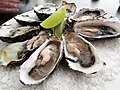 Pacific oysters
 -
 Oyster pits in Yerseke, Netherlands
 -
 Pacific cupped oyster total production (thousand tonnes) 1950-2022


