Wild rice: Difference between revisions
CSV import |
CSV import |
||
| Line 30: | Line 30: | ||
[[Category:Food]] | [[Category:Food]] | ||
{{food-stub}} | {{food-stub}} | ||
<gallery> | |||
File:Zizania_palustris_(20150198216).jpg|Zizania palustris | |||
File:Wild_rice_harvesting_19th_century.jpg|Wild rice harvesting in the 19th century | |||
File:Ojibwa_cedarbark_bag_rice_ANHM.jpg|Ojibwa cedar bark bag for rice | |||
File:Processed_wild_rice_at_Wild_Rice_House_in_Finland,_Minnesota_(51432379817).jpg|Processed wild rice at Wild Rice House in Finland, Minnesota | |||
File:wild_rice_stems.jpg|Wild rice stems | |||
File:wildricecooked.jpg|Cooked wild rice | |||
File:Paul_Buffalo_and_wife_parching_wild_rice_at_their_camp_-_NARA_-_285212.tif|Paul Buffalo and wife parching wild rice at their camp | |||
</gallery> | |||
Latest revision as of 11:35, 18 February 2025
Wild rice (Zizania) is a group of four species of grasses forming the genus Zizania, and the grain that can be harvested from them. The grain was historically gathered and eaten in North America, India and China. While now a delicacy in North America, the grain is eaten less in China, where the plant's stem is used as a vegetable.
Description[edit]
Wild rice is not directly related to Asian rice (Oryza sativa), which is known as "true rice". It is a tall, annual aquatic grass with a grain that is longer and more slender than that of regular rice. The plants grow in shallow water in small lakes and slow-flowing streams and can reach up to 3 meters in height.
Species[edit]
There are four species of wild rice, three of which are native to North America:
- Zizania aquatica
- Zizania palustris
- Zizania texana
- Zizania latifolia (Manchurian wild rice), the only species native to Asia.
Cultivation and Harvesting[edit]
Wild rice is grown commercially in the United States, Canada, and Australia. It is planted on flooded fields and harvested using two methods: "knocking" the ripe grain into the canoe with two sticks, or by collecting the grain after it has fallen naturally to the ground.
Nutritional Value[edit]
Wild rice is a good source of fiber, protein, and antioxidants. It is also rich in vitamin B, magnesium, and phosphorus. It is gluten-free and can be used as a substitute for rice in most recipes.
Cultural Significance[edit]
Wild rice has a significant role in the culture of many Native American tribes in North America, who consider it a sacred component of their culture and spirituality.
See Also[edit]

-
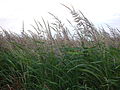 Zizania palustris
 -
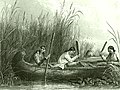 Wild rice harvesting in the 19th century
 -
 Ojibwa cedar bark bag for rice
 -
 Processed wild rice at Wild Rice House in Finland, Minnesota
 -
Wild rice stems
-
Cooked wild rice
-
Paul Buffalo and wife parching wild rice at their camp
.jpg)


.jpg)


