Trillium undulatum: Difference between revisions
CSV import |
CSV import |
||
| Line 54: | Line 54: | ||
[[Category:Flora of the Northeastern United States]] | [[Category:Flora of the Northeastern United States]] | ||
[[Category:Flora of Eastern Canada]] | [[Category:Flora of Eastern Canada]] | ||
<gallery> | |||
File:Trillium_undulatum.jpg|Trillium undulatum | |||
File:Trillium_undulatum_seedling_Vermont_August_2021.jpg|Trillium undulatum seedling in Vermont, August 2021 | |||
File:2014-05-20_Bloc_B_JPA_(3).jpg|Trillium undulatum | |||
File:Trillium_fruit.jpg|Trillium fruit | |||
File:Trillium_undulatum_seeds_Vermont_August_2020.jpg|Trillium undulatum seeds in Vermont, August 2020 | |||
File:Trillium_undulatum_(four-leaf)_Vermont_2019-07-18.jpg|Trillium undulatum (four-leaf) in Vermont, July 18, 2019 | |||
File:Trillium_undulatum_in_the_USA.svg|Trillium undulatum in the USA | |||
</gallery> | |||
Revision as of 11:32, 18 February 2025
Species of flowering plant
Trillium undulatum, commonly known as the painted trillium, is a species of flowering plant in the family Melanthiaceae. It is native to the northeastern United States and eastern Canada.
Description
Trillium undulatum is a perennial herbaceous plant that grows from a rhizome. It typically reaches a height of 15 to 40 cm. The plant is characterized by its three broad, wavy-margined leaves that are arranged in a whorl. The leaves are typically green with a distinctive mottled pattern.
The flower of T. undulatum is its most striking feature. It has three white petals with a central pink or red "V"-shaped marking. The petals are wavy and can be up to 5 cm long. The flower blooms in late spring to early summer.
Distribution and habitat
Trillium undulatum is found in cool, moist, acidic woodlands. It prefers shaded areas with rich, well-drained soil. The species is distributed across the northeastern United States, including states such as Maine, New York, and Pennsylvania, and extends into eastern Canada, including Quebec and Nova Scotia.
Ecology
The painted trillium is pollinated by insects, including bees and flies. The plant's seeds are dispersed by ants, a process known as myrmecochory. The seeds have a fleshy appendage called an elaiosome, which attracts ants.
Conservation
Trillium undulatum is considered to be of conservation concern in some areas due to habitat loss and over-collection. Efforts to conserve its habitat are important for maintaining healthy populations of this species.
Gallery
-
 Trillium undulatum in bloom
 -
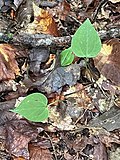 Seedling in Vermont
 -
 Habitat of T. undulatum
 -
 Fruit of T. undulatum
 -
 Seeds of T. undulatum
 -
 Four-leaf variant
 -
 Distribution map in the USA


.jpg)


_Vermont_2019-07-18.jpg)

Related pages
References
- Case, F. W., & Case, R. B. (1997). Trilliums. Timber Press.
- Gleason, H. A., & Cronquist, A. (1991). Manual of Vascular Plants of Northeastern United States and Adjacent Canada. New York Botanical Garden.
-
Trillium undulatum
-
Trillium undulatum seedling in Vermont, August 2021
-
Trillium undulatum
-
Trillium fruit
-
Trillium undulatum seeds in Vermont, August 2020
-
Trillium undulatum (four-leaf) in Vermont, July 18, 2019
-
Trillium undulatum in the USA
