Horned puffin: Difference between revisions
CSV import Tags: mobile edit mobile web edit |
CSV import |
||
| Line 23: | Line 23: | ||
[[Category:Agriculture in Africa]] | [[Category:Agriculture in Africa]] | ||
{{fruit-stub}} | {{fruit-stub}} | ||
<gallery> | |||
File:Horned_Puffin_RWD1.jpg|Horned puffin | |||
File:Horned_Puffin_RWD3.jpg|Horned puffin | |||
File:Horned_Puffin,_near_Chisik_Island_in_Lower_Cook_Inlet,_Alaska.jpg|Horned puffin near Chisik Island in Lower Cook Inlet, Alaska | |||
File:Horned_Puffin_RWD4.jpg|Horned puffin | |||
File:Horned_Puffin_with_egg_on_Aiktak_Island_by_Mikaela_Howie_USFWS.jpg|Horned puffin with egg on Aiktak Island | |||
File:Fratercula_corniculataUSFWS-DI-AMNWR-0438A.jpg|Horned puffin | |||
</gallery> | |||
Latest revision as of 11:31, 18 February 2025
Horned Melon
The Horned Melon (Cucumis metuliferus), also known as Kiwano, African Horned Cucumber, Jelly Melon, or Melano, is a unique fruit native to Sub-Saharan Africa. It is now grown in various parts of the world, including California, Mississippi, Chile, Australia, and New Zealand.
Description[edit]
The Horned Melon is notable for its distinctive appearance. It has a bright orange-yellow exterior covered in small spiky protrusions, hence the name "Horned Melon". The interior of the fruit is filled with a green, jelly-like flesh containing numerous small seeds.
Cultivation[edit]
The Horned Melon is a vine plant that grows well in semi-arid climates. It is typically planted in the spring and harvested in the late summer or early fall. The plant prefers well-drained soil and requires regular watering.
Nutritional Value[edit]
The Horned Melon is rich in Vitamin C and Dietary fiber. It also contains small amounts of Vitamin A, Vitamin B6, and Vitamin B12. The seeds are edible and are a good source of Omega-3 and Omega-6 fatty acids.
Culinary Uses[edit]
The Horned Melon can be eaten raw or used in cooking. The fruit's unique flavor, described as a combination of banana, cucumber, and lime, makes it a popular ingredient in salads, desserts, and beverages.
See Also[edit]
-
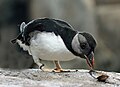 Horned puffin
 -
 Horned puffin
 -
 Horned puffin near Chisik Island in Lower Cook Inlet, Alaska
 -
Horned puffin
-
Horned puffin with egg on Aiktak Island
-
Horned puffin


