Chrysobalanus icaco: Difference between revisions
CSV import |
CSV import |
||
| Line 28: | Line 28: | ||
{{plants-stub}} | {{plants-stub}} | ||
==Chrysobalanus icaco== | |||
<gallery> | |||
File:Chrysobalanus_icaco_(inflorescense).jpg|Chrysobalanus icaco inflorescence | |||
File:Starr_031108-2013_Chrysobalanus_icaco.jpg|Chrysobalanus icaco | |||
File:Starr_031108-2137_Chrysobalanus_icaco.jpg|Chrysobalanus icaco | |||
File:Oleta_River_State_Park_-_Chrysobalanus_icaco_-_Cocoplum_fruit_03.jpg|Cocoplum fruit | |||
File:Oleta_River_State_Park_-_Chrysobalanus_icaco_-_Cocoplum_leaves_01.jpg|Cocoplum leaves | |||
File:Oleta_River_State_Park_-_Chrysobalanus_icaco_-_Cocoplum_fruit_01.jpg|Cocoplum fruit | |||
</gallery> | |||
Latest revision as of 11:31, 18 February 2025
Chrysobalanus icaco, commonly known as the coco plum or icaco, is a species of flowering plant in the family Chrysobalanaceae. It is native to coastal regions of the tropical Americas, including the Caribbean, Central America, and South America.
Description[edit]
The Chrysobalanus icaco is a shrub or small tree that typically grows to a height of 2–6 meters. It has evergreen leaves that are simple, alternate, and elliptical. The flowers are small, white, and produced in clusters. The fruit is a drupe, varying in color from white to pink to dark purple.
Distribution and habitat[edit]
The Chrysobalanus icaco is found in a variety of coastal habitats, including mangrove forests, beach dunes, and coastal hammocks. It is tolerant of salt spray and can grow in both full sun and partial shade.
Uses[edit]
The fruit of the Chrysobalanus icaco is edible and has been used in traditional medicine for the treatment of a variety of ailments. The wood of the plant is also used for making tools and furniture.
Cultivation[edit]
The Chrysobalanus icaco is often grown as an ornamental plant for its attractive foliage and fruit. It is also used in landscaping for erosion control and as a windbreak.
Conservation[edit]
While the Chrysobalanus icaco is not currently considered threatened, it is vulnerable to habitat loss due to coastal development and climate change.
See also[edit]
This plant related article is a stub. You can help WikiMD by expanding it.
Chrysobalanus icaco[edit]
-
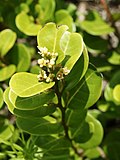 Chrysobalanus icaco inflorescence
 -
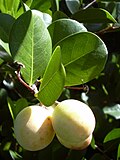 Chrysobalanus icaco
 -
Chrysobalanus icaco
-
Cocoplum fruit
-
Cocoplum leaves
-
Cocoplum fruit
.jpg)


