Computed tomography angiography: Difference between revisions
CSV import Tags: mobile edit mobile web edit |
CSV import |
||
| Line 28: | Line 28: | ||
{{stub}} | {{stub}} | ||
{{dictionary-stub1}} | {{dictionary-stub1}} | ||
<gallery> | |||
File:SagitalAAA.jpg|Computed tomography angiography of an abdominal aortic aneurysm | |||
File:Abdominal_CT_angiography.jpg|Abdominal CT angiography | |||
File:CTA_FMD.jpg|CT angiography showing fibromuscular dysplasia | |||
File:CT_angiography_of_a_vascular_malformation_with_intraventricular_hemorrhage.png|CT angiography of a vascular malformation with intraventricular hemorrhage | |||
File:CT_angiography_of_the_head_without_and_with_bone_removal.jpg|CT angiography of the head without and with bone removal | |||
File:Volume_rendered_CT_scan_of_abdominal_and_pelvic_blood_vessels_(smaller).gif|Volume rendered CT scan of abdominal and pelvic blood vessels | |||
</gallery> | |||
Latest revision as of 11:30, 18 February 2025
Computed Tomography Angiography (often abbreviated as CTA) is a medical diagnostic tool that combines the technology of a CT scan with that of traditional Angiography. This allows for detailed visualization of the blood vessels in key areas of the body.
Overview[edit]
CTA is a non-invasive procedure that uses x-ray technology to visualize the blood vessels in the body. It is often used to diagnose and evaluate various vascular disorders such as aneurysms, atherosclerosis, and blood clots. It can also be used to assess the blood vessels in and around the heart, brain, lungs, kidneys, and other areas of the body.
Procedure[edit]
During a CTA, the patient is positioned on a CT scanner table. A contrast material, usually iodine-based, is then injected into a vein. The CT scanner then takes a series of images as the contrast material travels through the blood vessels. These images are then processed by a computer to create detailed images of the blood vessels.
Risks and Complications[edit]
As with any medical procedure, there are potential risks and complications associated with CTA. These may include allergic reactions to the contrast material, kidney damage, and radiation exposure. However, the benefits of CTA often outweigh these risks, especially when it is used to diagnose or evaluate serious vascular conditions.
See Also[edit]
 | |
|---|---|
 |
 |
-
 Computed tomography angiography of an abdominal aortic aneurysm
 -
 Abdominal CT angiography
 -
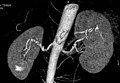 CT angiography showing fibromuscular dysplasia
 -
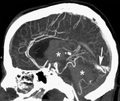 CT angiography of a vascular malformation with intraventricular hemorrhage
 -
 CT angiography of the head without and with bone removal
 -
 Volume rendered CT scan of abdominal and pelvic blood vessels


.gif)
