Demography: Difference between revisions
CSV import Tags: mobile edit mobile web edit |
CSV import |
||
| Line 32: | Line 32: | ||
[[Category:Sociology]] | [[Category:Sociology]] | ||
[[Category:Statistics]] | [[Category:Statistics]] | ||
== Demography == | |||
<gallery> | |||
File:Global_Population-Pyramid-1950-to-2100.jpg|Global Population Pyramid 1950 to 2100 | |||
File:1888-01-22,_La_Ilustración_Española_y_Americana,_El_censo_de_población,_Alcázar.jpg|El censo de población, Alcázar | |||
File:Población_Mundial.svg|Población Mundial | |||
File:World_population_growth_-_time_between_each_billion-person_growth.svg|World population growth - time between each billion-person growth | |||
File:Population_by_broad_age_group_projected_to_2100,_OWID.svg|Population by broad age group projected to 2100 | |||
</gallery> | |||
Latest revision as of 11:28, 18 February 2025
Demography is the statistical study of populations, especially human beings. As a very general science, it can analyze any kind of dynamic living population, i.e., one that changes over time or space (see population dynamics). Demography encompasses the study of the size, structure, and distribution of these populations, and spatial or temporal changes in them in response to birth, migration, aging, and death.
Overview[edit]
Demographic analysis can cover whole societies or groups defined by criteria such as education, nationality, religion, and ethnicity. Educational institutions usually treat demography as a field of sociology, though there are a number of independent demography departments.
Formal demography limits its object of study to the measurement of population processes, while the broader field of social demography or population studies also analyzes the relationships between economic, social, cultural, and biological processes influencing a population.
History[edit]
The term "demography" is of French origin and was first coined by Achille Guillard in 1855. However, the study of human populations and how they change dates back to antiquity. Early demographers were more concerned with counting population size than with examining the structures of populations.
Methods[edit]
Demographic research methods have largely been developed in the 20th century. These methods include the collection of data from vital statistics registries and through censuses, surveys, interviews, and other studies. Demographers also use mathematical models to simulate future demographic trends.
See also[edit]
References[edit]
<references />
 | This medical article is a stub. You can help WikiMD by expanding the page. |
Demography[edit]
-
 Global Population Pyramid 1950 to 2100
 -
 El censo de población, Alcázar
 -
 Población Mundial
 -
 World population growth - time between each billion-person growth
 -
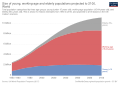 Population by broad age group projected to 2100


