Liquid fluoride thorium reactor: Difference between revisions
CSV import |
CSV import |
||
| Line 23: | Line 23: | ||
[[Category:Nuclear reactors]] | [[Category:Nuclear reactors]] | ||
{{Energy-stub}} | {{Energy-stub}} | ||
<gallery> | |||
File:FLiBe.png|FLiBe salt used in liquid fluoride thorium reactors | |||
File:NAMrad_Th_let.gif|Thorium decay chain | |||
File:Amr-thorite.jpg|Thorite mineral containing thorium | |||
File:MSRE_Reactor.JPG|Molten-Salt Reactor Experiment (MSRE) reactor | |||
File:MSRCutAway.png|Cutaway view of a molten salt reactor | |||
File:Rankine_cycle_layout.png|Rankine cycle layout used in power generation | |||
File:Schem_turb_gaz3_en-simple.svg|Simple schematic of a gas turbine | |||
File:Lwrvslftr2.png|Comparison of light water reactor and liquid fluoride thorium reactor | |||
</gallery> | |||
Latest revision as of 11:28, 18 February 2025
Liquid Fluoride Thorium Reactor (LFTR) is a type of Molten Salt Reactor (MSR) that uses thorium in the form of a molten salt mixture as fuel. The LFTR is a type of nuclear reactor that is designed to use a liquid fuel, rather than the solid fuel rods used in conventional nuclear reactors. This allows for a much more efficient and safe operation, as the liquid fuel can be continuously circulated and cooled, reducing the risk of a meltdown.
History[edit]
The concept of the LFTR was first proposed in the 1950s by Alvin Weinberg and his team at the Oak Ridge National Laboratory in the United States. The idea was to create a reactor that could not only produce electricity, but also breed its own fuel, making it a potentially limitless source of power. However, due to political and technical challenges, the development of the LFTR was halted in the 1970s.
Design and Operation[edit]
The LFTR operates by circulating a liquid fuel mixture of lithium fluoride and thorium fluoride through a core of graphite moderators. The thorium in the fuel mixture absorbs neutrons and transmutes into uranium-233, a fissile material. The uranium-233 then undergoes fission, releasing energy and additional neutrons, which continue the reaction.
One of the key advantages of the LFTR is its high thermal efficiency. Because the fuel is in liquid form, it can be circulated and cooled more effectively than solid fuel rods. This allows the reactor to operate at higher temperatures and pressures, resulting in higher efficiency.
Safety and Waste Disposal[edit]
The LFTR has several safety features that make it less prone to accidents than conventional nuclear reactors. The liquid fuel can be drained from the reactor core into a passive cooling system in the event of a power failure or overheating, preventing a meltdown. Additionally, the LFTR produces less long-lived radioactive waste than other types of reactors, as the thorium fuel cycle does not produce plutonium or other transuranic elements.
Future Development[edit]
Despite the potential benefits of the LFTR, there are still many technical and regulatory challenges to be overcome before it can be commercially viable. However, several countries, including China and India, are currently conducting research and development on LFTR technology, with the aim of making it a viable alternative to conventional nuclear power in the future.

-
 FLiBe salt used in liquid fluoride thorium reactors
 -
 Thorium decay chain
 -
 Thorite mineral containing thorium
 -
 Molten-Salt Reactor Experiment (MSRE) reactor
 -
 Cutaway view of a molten salt reactor
 -
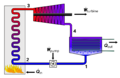 Rankine cycle layout used in power generation
 -
 Simple schematic of a gas turbine
 -
 Comparison of light water reactor and liquid fluoride thorium reactor


