Sit-in: Difference between revisions
CSV import |
CSV import |
||
| Line 24: | Line 24: | ||
{{Activism-stub}} | {{Activism-stub}} | ||
<gallery> | |||
File:Benjamin_Cowins_during_a_sit-in_at_McCrory's_lunch_counter_in_Tallahassee.jpg|Sit-in | |||
File:Sitdown_outside_Victorian_Parliament_-_-climatestrike_Melbourne_IMG_3522_(45203540215).jpg|Sit-in | |||
File:20081106_Executive_Yuan_Human_Rights_Sit-in.jpg|Sit-in | |||
File:Ligetvédők_(9).JPG|Sit-in | |||
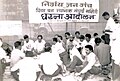
File:Dharna_by_Nirbhay_Jan_Manch_in_Virar.jpg|Sit-in | |||
</gallery> | |||
Latest revision as of 11:27, 18 February 2025
Sit-in is a form of direct action that involves one or more people occupying an area for a protest, often to promote political, social, or economic change. The sit-in movement has been an important part of the civil rights movement in the United States, as well as other social justice movements around the world. Sit-ins are a nonviolent way to protest and have been used to challenge and change discriminatory laws and practices, particularly in the areas of racial segregation and labor rights.
History[edit]
The history of sit-ins can be traced back to the early 20th century. However, they became a prominent tactic during the 1960s, particularly in the American civil rights movement. One of the most famous sit-ins took place at a Woolworth's lunch counter in Greensboro, North Carolina, in 1960. Four African American students from North Carolina Agricultural and Technical State University sat at a segregated lunch counter and refused to leave after being denied service. This event sparked a sit-in movement across the country, leading to the desegregation of many public spaces.
Tactics[edit]
Sit-ins involve participants sitting down in a strategic location, such as a government building, university, roadway, or business that is the target of the protest. The goal is often to disrupt normal operations and draw attention to the cause. Participants may risk arrest and physical harm, as sit-ins can provoke violent reactions from authorities or counter-protesters. Despite these risks, sit-ins are a powerful tool for social change due to their nonviolent nature and ability to garner public sympathy and media attention.
Legal and Social Implications[edit]
Sit-ins have played a significant role in changing laws and social norms. The success of sit-in protests in the 1960s, particularly those targeting segregation, led to significant legal changes, including the Civil Rights Act of 1964, which outlawed discrimination based on race, color, religion, sex, or national origin in public places and employment. Sit-ins have also influenced public opinion, making them a critical aspect of social movements.
Contemporary Use[edit]
While sit-ins are most commonly associated with the civil rights movement of the 1960s, they continue to be used as a form of protest. Modern sit-ins have addressed issues such as climate change, economic inequality, and police brutality. The tactic has evolved with technology, with some sit-ins being organized and broadcasted through social media, increasing their reach and impact.
See Also[edit]

-
 Sit-in
 -
 Sit-in
 -
 Sit-in
 -
 Sit-in
 -
 Sit-in

.jpg)

.JPG)

