Gold(III) chloride: Difference between revisions
CSV import Tags: mobile edit mobile web edit |
CSV import |
||
| Line 25: | Line 25: | ||
{{Chem-stub}} | {{Chem-stub}} | ||
<gallery> | |||
File:Gold(III)_chloride_solution.jpg|Gold(III) chloride solution | |||
File:Example_of_gold-catalyzed_alkyne_hydration_reaction.svg|Example of gold-catalyzed alkyne hydration reaction | |||
File:Alkylation_reaction_of_2-methylfuran_with_methyl_vinyl_ketone.svg|Alkylation reaction of 2-methylfuran with methyl vinyl ketone | |||
File:AuCl3_phenol_synthesis.svg|AuCl3 phenol synthesis | |||
File:Hydroarylation_reetz.png|Hydroarylation reaction | |||
File:Example_of_oxidation_by_AuCl3.png|Example of oxidation by AuCl3 | |||
</gallery> | |||
Latest revision as of 11:27, 18 February 2025
_chloride.jpg)
Gold(III) chloride, traditionally known as auric chloride, is a chemical compound of gold and chlorine. With the molecular formula AuCl3, it is a yellow-orange solid. Gold(III) chloride is a common starting material in gold chemistry, particularly in the formation of gold-based catalysts and as a precursor to gold nanoparticles.
Properties[edit]
Gold(III) chloride is highly soluble in water, where it forms acidic solutions. It can also dissolve in ethanol and acetone. When heated, gold(III) chloride decomposes to gold(III) oxide and chlorine gas. In its solid form, it exists in two polymorphs: a stable form with a monoclinic crystal structure and a metastable form with an orthorhombic crystal structure.
Synthesis[edit]
Gold(III) chloride can be synthesized by reacting gold with chlorine at elevated temperatures. Another method involves the chlorination of gold in the presence of aqua regia (a mixture of nitric acid and hydrochloric acid), which dissolves gold to form chloroauric acid (HAuCl4). The chloroauric acid can then be reduced to gold(III) chloride by heating or by adding a less noble metal such as sodium metabisulfite.
Applications[edit]
Gold(III) chloride is used in organic synthesis as a catalyst for reactions such as the cyclization of alkynes and the hydration of alkynes to ketones. It is also employed in the preparation of gold nanoparticles and in the decoration of ceramics and glass. In medicine, gold(III) chloride has been explored for its potential anti-cancer properties, though its use is limited due to its toxicity.
Safety[edit]
Gold(III) chloride is toxic if ingested, inhaled, or if it comes in contact with skin. It can cause severe irritation to the skin, eyes, and respiratory system. Appropriate safety measures, including the use of personal protective equipment, should be taken when handling this compound.
See also[edit]

-
 Gold(III) chloride solution
 -
 Example of gold-catalyzed alkyne hydration reaction
 -
 Alkylation reaction of 2-methylfuran with methyl vinyl ketone
 -
 AuCl3 phenol synthesis
 -
 Hydroarylation reaction
 -
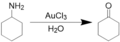 Example of oxidation by AuCl3
_chloride_solution.jpg)


