Fritillaria camschatcensis: Difference between revisions
CSV import Tags: mobile edit mobile web edit |
CSV import |
||
| Line 24: | Line 24: | ||
[[Category:Fritillaria]] | [[Category:Fritillaria]] | ||
{{Flora-stub}} | {{Flora-stub}} | ||
<gallery> | |||
File:Fritillaria_camschatcensis_20010706.jpg|Fritillaria camschatcensis | |||
File:Transactions_of_the_Linnean_Society_of_London,_Volume_10_-_tab._11-renewed.jpg|Fritillaria camschatcensis | |||
File:Fritillaria_camschatcensis_fma._flavescens_(L.)_Ker_Gawl.,_Bot._Mag._30_t._1216_(1809)_(49974232206).jpg|Fritillaria camschatcensis | |||
File:Fritillaria_camschatcensis_var._keisukei_(flower_f4).JPG|Fritillaria camschatcensis | |||
</gallery> | |||
Latest revision as of 11:25, 18 February 2025
Fritillaria camschatcensis, commonly known as the Kamchatka fritillary or chocolate lily, is a species of flowering plant in the lily family. It is native to northeastern Asia, including Siberia, the Korean Peninsula, Japan, and the Aleutian Islands of Alaska.
Description[edit]
The plant grows to a height of 10 to 40 cm, with a single, erect stem. The leaves are lanceolate and alternate, with the lower leaves being larger than the upper ones. The flowers are bell-shaped, nodding, and dark purple to almost black in color, giving rise to the common name "chocolate lily". The fruit is a capsule containing numerous seeds.
Habitat and Distribution[edit]
Fritillaria camschatcensis is found in a variety of habitats, including meadows, open forests, and coastal areas. It prefers moist, well-drained soils and is often found in areas with cool summers and cold winters. In Alaska, it is commonly found on the Aleutian Islands, while in Asia, it is widespread across Siberia and the Korean Peninsula, and is also found in northern Japan.
Uses[edit]
The bulbs of Fritillaria camschatcensis have been used as a food source by indigenous peoples in its native range. They are typically cooked before consumption, as they can be bitter when raw. The plant has also been used in traditional medicine, particularly in China, where it is known as beimu.
Conservation[edit]
While Fritillaria camschatcensis is not currently considered endangered, its habitat is threatened by climate change and human activity. Conservation efforts are focused on protecting its habitat and promoting sustainable harvesting practices.
See Also[edit]

This flora-related article is a stub. You can help WikiMD by expanding it.
-
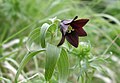 Fritillaria camschatcensis
 -
 Fritillaria camschatcensis
 -
 Fritillaria camschatcensis
 -
 Fritillaria camschatcensis


_Ker_Gawl.,_Bot._Mag._30_t._1216_(1809)_(49974232206).jpg)
.JPG)
