Pore-forming toxin: Difference between revisions
CSV import |
CSV import |
||
| Line 37: | Line 37: | ||
[[Category:Pathogens]] | [[Category:Pathogens]] | ||
{{Toxin-stub}} | {{Toxin-stub}} | ||
<gallery> | |||
File:7ahl.png|Pore-forming toxin | |||
File:Structural_comparison_of_pore-form_alpha-Haemolysin_(pink-red)_and_soluble-form_PVL_(pale_green-green)_toxins_-_PDB_7AHL_and_1T5R.png|Structural comparison of pore-form alpha-Haemolysin and soluble-form PVL toxins | |||
File:Molecular_model_of_the_pre-pore_form_of_a_MACPF_protein_based_upon_the_structure_of_pneunolysin.png|Molecular model of the pre-pore form of a MACPF protein | |||
File:PFO_and_Plu-MACPF.png|PFO and Plu-MACPF | |||
</gallery> | |||
Latest revision as of 11:25, 18 February 2025
Pore-forming toxins (PFTs) are a class of toxins, produced by a variety of pathogenic organisms, that disrupt cellular membranes. PFTs are the most common type of protein toxin and can be found in both Gram-positive and Gram-negative bacteria, as well as in eukaryotic organisms.
Structure and Function[edit]
PFTs are typically composed of multiple protein subunits that assemble into a ring structure on the target cell membrane. This ring structure forms a pore, or hole, in the membrane, disrupting the cell's normal function. The size and shape of the pore can vary depending on the specific toxin, but all PFTs function by creating these membrane disruptions.
PFTs can target a variety of cells, including erythrocytes, leukocytes, and epithelial cells. The specific target cell often depends on the producing organism and its pathogenic strategy.
Types of Pore-forming Toxins[edit]
There are several different types of PFTs, classified based on their structure and mechanism of action. These include:
- Alpha toxins: These toxins, produced by organisms such as Staphylococcus aureus, form pores by inserting a large alpha-helix into the membrane.
- Beta toxins: These toxins, such as Staphylococcus aureus beta toxin, form pores by inserting a beta-barrel into the membrane.
- Epsilon toxins: These toxins, produced by Clostridium perfringens, form pores by a mechanism that is not yet fully understood.
Role in Disease[edit]
PFTs play a key role in the pathogenesis of many bacterial infections. By disrupting cellular membranes, these toxins can cause cell death, tissue damage, and inflammation. In addition, some PFTs can modulate the immune response, helping the pathogen to evade the host's defenses.
PFTs are a major factor in diseases such as pneumonia, meningitis, and necrotizing fasciitis. They are also involved in the pathogenesis of some non-infectious diseases, such as multiple sclerosis and Alzheimer's disease.
Therapeutic Potential[edit]
Despite their role in disease, PFTs also have potential therapeutic uses. For example, they can be used to selectively kill cancer cells or to deliver drugs into cells. However, more research is needed to fully realize this potential.
See Also[edit]
This toxin-related article is a stub. You can help WikiMD by expanding it.
-
 Pore-forming toxin
 -
 Structural comparison of pore-form alpha-Haemolysin and soluble-form PVL toxins
 -
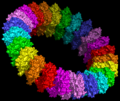 Molecular model of the pre-pore form of a MACPF protein
 -
 PFO and Plu-MACPF

_and_soluble-form_PVL_(pale_green-green)_toxins_-_PDB_7AHL_and_1T5R.png)


