Glossary of wine terms: Difference between revisions
CSV import Tags: mobile edit mobile web edit |
CSV import |
||
| Line 144: | Line 144: | ||
[[Category:Glossaries of drinks]] | [[Category:Glossaries of drinks]] | ||
{{food-stub}} | {{food-stub}} | ||
<gallery> | |||
File:Lightmatter_wine_barrels.jpg|Wine barrels | |||
File:Empty_Wine_bottle.jpg|Empty wine bottle | |||
File:Flute_Glass.svg|Flute glass | |||
File:Korkenzieher.jpg|Corkscrew | |||
File:Wine_serving_at_restaurant_with_drip_cloth.jpg|Wine serving at restaurant with drip cloth | |||
File:Roman_Flagons.jpg|Roman flagons | |||
File:Semi_Seco_rosado_cava.jpg|Semi Seco rosado cava | |||
File:Sommelier_Knife2.jpg|Sommelier knife | |||
File:The_caves_at_Inglenook_02.jpg|The caves at Inglenook | |||
</gallery> | |||
Revision as of 11:23, 18 February 2025
Glossary of Wine Terms
The Glossary of Wine Terms is a comprehensive list of terms and jargon used in the wine industry. This glossary is intended to provide a clear understanding of the terminology used in wine production, tasting, and evaluation.
A
Acidity: In wine, acidity is a crucial element that contributes to the overall balance of the wine. It adds crispness and vitality to the wine and is necessary for the wine's longevity.
Aftertaste: Also known as the finish, the aftertaste is the taste or flavors that linger in the mouth after the wine is tasted, spit or swallowed. The longer the aftertaste, the higher the quality of the wine.
B
Balance: A wine is said to be balanced when all its components – acidity, sugar, tannins, and alcohol – are in harmony with each other.
Body: The body of a wine refers to the perceived weight and fullness of the wine in the mouth. Wines can be light-bodied, medium-bodied, or full-bodied.
C
Corked: A term used to describe a wine that has been contaminated with cork taint, which is characterized by a musty, moldy, wet cardboard aroma and flavor.
Cuvée: A French term, generally used to denote a specific blend or batch of wine.
D
Decanting: The process of pouring wine from its bottle into a decanter to separate the sediment from the wine.
Dry: A term used to describe a wine that has no residual sugar and therefore is not sweet.
E
Enology: The science and study of wine and winemaking.
Extraction: The process of extracting color, flavor, and tannins from the grape skins during the fermentation process.
F
Fermentation: The process by which yeast converts the sugar in grapes into alcohol and carbon dioxide, producing wine.
Finish: See Aftertaste.
G
Grape Variety: The type of grape used to make a wine. Examples include Cabernet Sauvignon, Chardonnay, and Merlot.
Grafting: The process of attaching a cutting from a vine (the scion) to the rootstock of another vine. This is commonly done to protect vines from diseases and pests.
H
Harvest: The process of picking grapes. Also known as vintage.
Hybrid: A grape variety that is the result of crossing two or more grape species.
I
Irrigation: The practice of supplying water to vineyards to assist in the growth of grapevines.
J
Jug Wine: A term used to describe inexpensive, lower quality wine.
K
Kosher Wine: Wine that is produced under the supervision of a rabbi so as to be ritually pure or clean.
L
Lees: The sediment of dead yeast cells, grape pulp, seed, and other grape matter that accumulates during fermentation.
Legs: The streaks of wine that cling to the inside of a wine glass after the wine has been swirled. Also known as tears.
M
Magnum: A bottle holding 1.5 liters of wine, equivalent to two regular wine bottles.
Must: The freshly pressed juice that contains the skins, seeds, and stems of the fruit.
N
Nose: The aroma or bouquet of a wine.
O
Oenophile: A person who enjoys and appreciates wine.
Oxidation: A chemical reaction that occurs when wine comes into contact with air, causing it to spoil.
P
Palate: The perceived flavors of a wine in the mouth.
Phylloxera: A microscopic louse or aphid that feeds on the roots and leaves of grapevines, causing damage and eventually the death of the vine.
Q
Quality Wine: Wine that is made from specific grape varieties in a specific region and that meets certain quality standards.
R
Reserve: A term that often indicates a high-quality wine. However, the term is not regulated in all countries or regions.
Riddling: A process in making sparkling wine where the bottles are gradually turned and tilted to collect sediment in the neck of the bottle.
S
Sommelier: A trained and knowledgeable wine professional, typically working in fine restaurants, who specializes in all aspects of wine service as well as wine and food pairing.
Sulfites: Compounds (sulfur dioxide) that are added to wine to prevent oxidation and microbial spoilage.
T
Tannins: Naturally occurring compounds that exist in many natural sources including grapes and oak. In wine, tannins contribute to the color, bitterness, astringency and complexity.
Terroir: A French term used to describe the natural environment in which a wine is produced, including factors such as soil, topography, and climate.
U
Ullage: The space between the wine and the top of a wine bottle.
V
Varietal: A wine made from a single grape variety.
Vintage: The year in which the grapes were harvested.
W
Wine: An alcoholic beverage made from fermented grape juice.
Winemaker: The person who makes the wine, also known as a vintner.
X
Xinomavro: A red wine grape variety grown primarily in northern Greece.
Y
Yeast: Microorganisms that are used in winemaking for fermentation. They consume the sugar in grapes and convert it to alcohol.
Z
Zymology: The science of fermentation.

-
 Wine barrels
 -
Empty wine bottle
-
 Flute glass
 -
 Corkscrew
 -
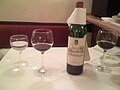 Wine serving at restaurant with drip cloth
 -
 Roman flagons
 -
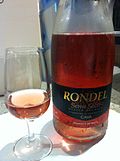 Semi Seco rosado cava
 -
 Sommelier knife
 -
 The caves at Inglenook


