Aestivation (botany): Difference between revisions
CSV import |
CSV import |
||
| Line 43: | Line 43: | ||
[[Category:Plant morphology]] | [[Category:Plant morphology]] | ||
[[Category:Botany]] | [[Category:Botany]] | ||
<gallery> | |||
File:Aestivation.png|Aestivation in botany | |||
File:Kashira_lilacs_01.JPG|Lilacs in bud | |||
File:Phlox_aestivation.jpg|Phlox flower bud | |||
File:Vinca_minor_aestivation.jpg|Vinca minor in bud | |||
File:Morning_Glory_Photo.jpg|Morning Glory flower | |||
File:Starr_070302-5063_Merremia_tuberosa.jpg|Merremia tuberosa flower | |||
</gallery> | |||
Latest revision as of 11:21, 18 February 2025
Aestivation (botany)

Aestivation in botany refers to the arrangement of sepals and petals in a flower bud before it opens. This arrangement is crucial for the identification and classification of flowering plants.
Types of Aestivation[edit]
Aestivation can be classified into several types based on the arrangement of the floral parts:
Valvate[edit]
In valvate aestivation, the sepals or petals meet at the edges without overlapping. This type is common in the family Malvaceae.
Twisted[edit]
Twisted aestivation is characterized by each petal or sepal overlapping the next one in a regular fashion. This is seen in the family Malvaceae and Convolvulaceae.
Imbricate[edit]
Imbricate aestivation involves overlapping of sepals or petals in an irregular manner. This type is found in the family Caesalpiniaceae.
Quincuncial[edit]
In quincuncial aestivation, two petals or sepals are completely outside, two are completely inside, and one is partly inside and partly outside. This arrangement is typical in the family Rosaceae.
Vexillary[edit]
Vexillary aestivation, also known as papilionaceous, is found in the family Fabaceae. It involves a large petal called the "standard" overlapping two lateral petals called "wings," which in turn overlap two inner petals called the "keel."
Significance of Aestivation[edit]
Aestivation is significant in the study of plant morphology and systematics. It helps in the identification of plant species and understanding their evolutionary relationships. The arrangement of floral parts can affect the pollination mechanism and the protection of reproductive organs.
Related pages[edit]
Gallery[edit]
-
 Lilac showing imbricate aestivation
 -
 Phlox with twisted aestivation
 -
 Vinca minor displaying valvate aestivation
 -
 Morning glory with twisted aestivation
 -
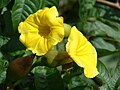 Merremia tuberosa showing twisted aestivation


-
 Aestivation in botany
 -
Lilacs in bud
-
Phlox flower bud
-
Vinca minor in bud
-
Morning Glory flower
-
Merremia tuberosa flower
