Electrospray ionization: Difference between revisions
CSV import Tags: mobile edit mobile web edit |
CSV import |
||
| Line 41: | Line 41: | ||
{{Chemistry-stub}} | {{Chemistry-stub}} | ||
<gallery> | |||
File:NanoESIFT.jpg|Electrospray ionization | |||
File:ESI_positive_mode_(21589986840).jpg|Electrospray ionization | |||
File:Fenn_ESI_Instrument.jpg|Electrospray ionization | |||
File:IEM,_CRM_and_CEM.png|Electrospray ionization | |||
File:DESI_ion_source.jpg|Electrospray ionization | |||
File:Diagram_of_a_SESI_ambient_ionization_source.png|Electrospray ionization | |||
File:SESI-MS.png|Electrospray ionization | |||
File:Electrospray_interface_on_the_LTQ.jpg|Electrospray ionization | |||
</gallery> | |||
Latest revision as of 11:20, 18 February 2025
Electrospray Ionization (ESI) is a technique used in mass spectrometry to produce ions using an electrospray in which a high voltage is applied to a liquid to create an aerosol. It is especially useful in producing ions from macromolecules because it overcomes the propensity of these molecules to fragment when ionized. ESI is a soft ionization technique, meaning it allows the ionization of molecules without causing significant fragmentation, which is particularly advantageous for the analysis of large, complex molecules such as proteins, peptides, and polymers.
Overview[edit]
Electrospray ionization works by applying a high voltage to a liquid to create a fine aerosol. Typically, the liquid is a solution containing the analyte of interest. As the liquid exits a narrow capillary, it is subjected to a high electric field, causing the surface of the liquid to charge and disperse into small droplets. The solvent from the droplets evaporates, leaving behind charged analyte molecules or ions. These ions can then be directed into the mass spectrometer for analysis.
History[edit]
The development of electrospray ionization is credited to John Fenn in the 1980s, for which he was awarded the Nobel Prize in Chemistry in 2002. Fenn's work demonstrated the utility of ESI in analyzing biological molecules, significantly impacting the field of analytical chemistry.
Applications[edit]
Electrospray ionization has a wide range of applications in the fields of chemistry, biochemistry, and molecular biology. It is particularly useful in the analysis of large biomolecules, such as DNA, proteins, and peptides, which are difficult to ionize by other methods. ESI has also been employed in the study of complex organic molecules, drug metabolites, and in the quantification of substances in various matrices.
Mechanism[edit]
The mechanism of electrospray ionization involves several steps: 1. Solution Dispersion: The solution containing the analyte is pumped through a narrow capillary tube. A high voltage is applied, causing the solution to disperse into a fine aerosol of charged droplets. 2. Solvent Evaporation: As the solvent evaporates, the droplets become smaller, and the charge density on their surface increases. 3. Coulomb Fission: When the charge density reaches a certain threshold, the droplet undergoes Coulomb fission, breaking into smaller droplets. 4. Ion Desorption: Eventually, the droplets become small enough that the surface tension can no longer contain the charge, leading to the release of gas-phase ions.
Advantages[edit]
Electrospray ionization offers several advantages over other ionization techniques: - It is a soft ionization technique, causing minimal fragmentation of the analyte. - It can ionize a wide range of compounds, including large biomolecules. - It is compatible with liquid chromatography, allowing for online analysis of complex mixtures. - It can produce multiple charged ions, facilitating the analysis of high molecular weight compounds.
Limitations[edit]
Despite its advantages, ESI also has some limitations: - It is less effective for non-polar compounds. - Ion suppression can occur when analyzing complex mixtures, affecting quantification. - The presence of salts and buffers in the sample can reduce ionization efficiency.
See Also[edit]

-
 Electrospray ionization
 -
 Electrospray ionization
 -
 Electrospray ionization
 -
 Electrospray ionization
 -
 Electrospray ionization
 -
 Electrospray ionization
 -
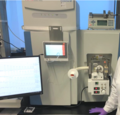 Electrospray ionization
 -
 Electrospray ionization

.jpg)


