Filter feeder: Difference between revisions
CSV import |
CSV import |
||
| Line 31: | Line 31: | ||
{{stub}} | {{stub}} | ||
{{dictionary-stub1}} | {{dictionary-stub1}} | ||
<gallery> | |||
File:Filterkrillkils2.gif|Filter_feeder | |||
File:Mysis2kils.jpg|Filter_feeder | |||
File:Squelette_de_baleine_australe.JPG|Southern right whale skeleton | |||
File:Callyspongia_sp._(Tube_sponge).jpg|Tube sponge | |||
File:Aureliaauritakils1.jpg|Filter_feeder | |||
File:Aureliaauritakils2.jpg|Filter_feeder | |||
File:Aureliaauritakils3.jpg|Filter_feeder | |||
File:Tunicate_komodo.jpg|Tunicate in Komodo | |||
File:Phoeniconaias_minor_01.jpg|Lesser flamingo | |||
</gallery> | |||
Latest revision as of 11:20, 18 February 2025
Filter feeder is a type of animal that feeds by straining suspended matter and food particles from water, typically by passing the water over a specialized filtering structure. Some animals that use this method of feeding are clams, krill, sponges, baleen whales, and many types of fish and birds.
Overview[edit]
Filter feeders can play an important role in clarifying water, and are therefore considered beneficial to the water quality of aquatic environments. They are often key species in various ecosystems and can contribute to the health of coral reefs, estuaries, and other aquatic habitats.
Types of Filter Feeders[edit]
Passive Filter Feeders[edit]
Passive filter feeders, such as sponges, corals, and bivalves, rely on the movement of the water to bring food particles to them. They typically have a filtering structure, such as a net or a sieve, that traps food particles as the water passes through.
Active Filter Feeders[edit]
Active filter feeders, such as baleen whales and certain types of fish, actively seek out concentrations of plankton. They often have specialized structures, such as baleen plates or gill rakers, that they use to filter the water for food.
Impact on Ecosystems[edit]
Filter feeders can have a significant impact on their ecosystems. They can help to control algae populations, contribute to nutrient cycling, and provide habitat for other species. However, they can also be vulnerable to changes in water quality and can be affected by pollution and other environmental stressors.
See Also[edit]
 | |
|---|---|
 |
 |
This article is a medical stub. You can help WikiMD by expanding it!
-
 Filter_feeder
 -
 Filter_feeder
 -
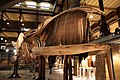 Southern right whale skeleton
 -
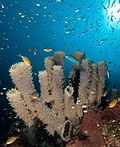 Tube sponge
 -
Filter_feeder
-
Filter_feeder
-
Filter_feeder
-
Tunicate in Komodo
-
Lesser flamingo


.jpg)


