Counterion: Difference between revisions
CSV import |
CSV import |
||
| Line 22: | Line 22: | ||
{{Chemistry-stub}} | {{Chemistry-stub}} | ||
{{Biochemistry-stub}} | {{Biochemistry-stub}} | ||
<gallery> | |||
File:Lithium-tetrakis(pentafluorophenyl)borate-2D-skeletal.png|Lithium tetrakis(pentafluorophenyl)borate | |||
File:Tetraphenylborate.png|Tetraphenylborate | |||
File:PF6.png|Hexafluorophosphate | |||
File:Tetrafluoroborate-ion-3D-balls.png|Tetrafluoroborate ion | |||
File:PPNCl.png|Bis(triphenylphosphine)iminium chloride | |||
File:PPh4Cl.png|Tetraphenylphosphonium chloride | |||
File:Tetrabutylammonium_bromide.svg|Tetrabutylammonium bromide | |||
File:Bis(12-crown-4)lithium-cation-from-xtal-3D-balls-B.png|Bis(12-crown-4)lithium cation | |||
</gallery> | |||
Latest revision as of 11:19, 18 February 2025
Counterion refers to the ion that accompanies an ionic species in order to maintain electric neutrality. In chemistry, counterions are often discussed in the context of salts and ionic compounds, where they balance the charge of the other ion in the compound. The concept is also crucial in biochemistry, particularly in the study of biomolecules and cell membranes, where counterions play significant roles in the structure and function of proteins and nucleic acids.
Overview[edit]
In an ionic compound, the total positive charge must equal the total negative charge, ensuring the compound is electrically neutral. The ion that is not the primary subject of discussion but serves to balance the charge is known as the counterion. For example, in sodium chloride (NaCl), sodium (Na+) acts as the counterion to chloride (Cl−), and vice versa. Counterions can significantly influence the physical and chemical properties of ionic compounds, including their solubility, melting point, and reactivity.
Role in Biochemistry[edit]
In biochemistry, counterions are essential for the stability and function of macromolecules. For proteins, counterions can affect their folding, stability, and interaction with other molecules. In the case of nucleic acids like DNA and RNA, counterions neutralize the negative charges of the phosphate backbone, affecting their structure and interactions with proteins.
Types of Counterions[edit]
Counterions can be categorized into two main types based on their charge: cations and anions. Cations are positively charged ions, while anions are negatively charged. The choice of counterion can affect the properties of the ionic compound. For example, a bulky counterion might increase the solubility of a compound in organic solvents, while a smaller counterion might favor solubility in water.
Applications[edit]
Counterions find applications in various fields, including pharmaceuticals, where they are used to form salts of drugs to modify their solubility and absorption characteristics. In polymer science, counterions can influence the behavior of polyelectrolytes, which are polymers that carry multiple charged groups.
Environmental and Health Considerations[edit]
The choice of counterion can also have environmental and health implications. For instance, certain counterions may be more toxic or less biodegradable than others, affecting the overall safety and environmental impact of the compound.

.svg)
This article is a biochemistry stub. You can help WikiMD by expanding it!
-
Lithium tetrakis(pentafluorophenyl)borate
-
 Tetraphenylborate
 -
 Hexafluorophosphate
 -
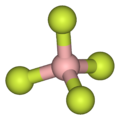 Tetrafluoroborate ion
 -
 Bis(triphenylphosphine)iminium chloride
 -
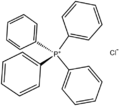 Tetraphenylphosphonium chloride
 -
 Tetrabutylammonium bromide
 -
 Bis(12-crown-4)lithium cation


lithium-cation-from-xtal-3D-balls-B.png)

borate-2D-skeletal.png)