Vespula vulgaris: Difference between revisions
CSV import Tags: mobile edit mobile web edit |
CSV import |
||
| Line 27: | Line 27: | ||
[[Category:Vespula]] | [[Category:Vespula]] | ||
{{Insect-stub}} | {{Insect-stub}} | ||
<gallery> | |||
File:Vespula_vulgaris_queen.jpg|Vespula vulgaris queen | |||
File:Flying_Vespula_vulgaris.jpg|Flying Vespula vulgaris | |||
File:Waspnest_with_wasps.jpeg|Wasp nest with wasps | |||
File:Sting_of_Queen_Wasp.jpg|Sting of Queen Wasp | |||
File:Vespula_vulgaris_SEM_Antenna_03.jpg|Vespula vulgaris SEM Antenna | |||
File:Common_wasp,_Queen_and_nest.jpg|Common wasp, Queen and nest | |||
File:Vespula_vulgaris_portrait.jpg|Vespula vulgaris portrait | |||
File:Vespula_vulgaris-m.jpg|Vespula vulgaris | |||
</gallery> | |||
Latest revision as of 11:18, 18 February 2025
Vespula vulgaris, commonly known as the common wasp, is a species of wasp native to the Palearctic region, but has since spread to North America, New Zealand, and Australia. It is a member of the Vespidae family and the Vespula genus.
Description[edit]
The Vespula vulgaris is a medium-sized wasp, with workers measuring 12-17mm in length, and queens measuring 20mm. They are easily identifiable by their distinctive yellow and black markings and the anchor-shaped mark on their face.
Distribution and habitat[edit]
Vespula vulgaris is native to the Palearctic region, but has since spread to other parts of the world. It is commonly found in woodland areas, gardens, and meadows, where it builds its nests in the ground or in cavities in walls and trees.
Behaviour and ecology[edit]
Vespula vulgaris is a social wasp, living in colonies of up to 5000 individuals. The colony is established in the spring by a single fertilised queen, who lays the eggs that will develop into workers. The workers then take over the task of expanding the nest and caring for the young, while the queen continues to lay eggs.
Interaction with humans[edit]
While Vespula vulgaris is generally not aggressive unless provoked, it can be a nuisance to humans due to its attraction to sweet foods and drinks. It can also pose a threat to those who are allergic to wasp stings.
Conservation status[edit]
The Vespula vulgaris is not currently considered to be at risk of extinction. However, like many other insect species, it may be affected by habitat loss and the use of pesticides.
See also[edit]
References[edit]
<references />

-
 Vespula vulgaris queen
 -
 Flying Vespula vulgaris
 -
 Wasp nest with wasps
 -
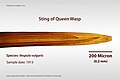 Sting of Queen Wasp
 -
 Vespula vulgaris SEM Antenna
 -
 Common wasp, Queen and nest
 -
 Vespula vulgaris portrait
 -
 Vespula vulgaris


