Finger millet: Difference between revisions
CSV import |
CSV import |
||
| Line 31: | Line 31: | ||
{{Nutrition-stub}} | {{Nutrition-stub}} | ||
{{Food-security-stub}} | {{Food-security-stub}} | ||
<gallery> | |||
File:Eleusine_coracana_MHNT.BOT.2015.34.17.jpg|Eleusine coracana specimen | |||
File:Millet_fields_in_Annapurna.png|Millet fields in Annapurna | |||
File:Ragi_Plant.jpg|Ragi Plant | |||
File:A_handful_of_hope_in_Gulu,_northern_Uganda_(6721454911).jpg|A handful of hope in Gulu, northern Uganda | |||
File:Ragi_Porridge.jpg|Ragi Porridge | |||
File:RAGI_MUDDE.JPG|Ragi Mudde | |||
File:Finger_millet_putt_uplads_by_Vijayanrajapuram_01.jpg|Finger millet putt | |||
</gallery> | |||
Latest revision as of 11:17, 18 February 2025
Finger millet (Eleusine coracana), also known as ragi in India, is a cereal crop grown in the arid and semiarid areas in Africa and Asia. It is a staple food in many parts of the world, especially in India, Nepal, and parts of Africa.
Description[edit]
Finger millet is an annual herbaceous plant widely grown as a cereal crop in the arid and semiarid areas in Africa and Asia. It is a tetraploid and self-pollinating species probably evolved from its wild relative Eleusine africana.
Cultivation[edit]
Finger millet is grown in fields and farms in many parts of the world. It is a hardy crop that can grow in high altitudes and withstand harsh weather conditions, making it very suitable for areas with poor rainfall. The crop is often intercropped with legumes, such as peanuts, cowpeas, and pigeon peas, or other cereals, such as maize or sorghum.
Nutritional Value[edit]
Finger millet has high nutritional value. It is a rich source of natural iron, calcium, fiber, and other minerals. It is also high in protein and contains important amino acids, which are essential for human health.
Uses[edit]
Finger millet is used in various culinary applications. It can be ground into flour and used to make bread, porridge, and other food products. In India, it is commonly used to make a type of flatbread called roti. It is also used in brewing to make traditional African beers.
Health Benefits[edit]
Finger millet has several health benefits. It is a good source of natural iron and can help in treating anemia. It is also beneficial for bone health due to its high calcium content. The high fiber content in finger millet can help in managing diabetes by controlling blood sugar levels.
See Also[edit]
This cereal related article is a stub. You can help WikiMD by expanding it.

This article is a agriculture stub. You can help WikiMD by expanding it!

 This food security related article is a stub. You can help WikiMD by expanding it.
-
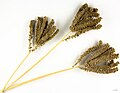 Eleusine coracana specimen
 -
 Millet fields in Annapurna
 -
 Ragi Plant
 -
 A handful of hope in Gulu, northern Uganda
 -
 Ragi Porridge
 -
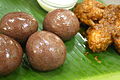 Ragi Mudde
 -
 Finger millet putt


.jpg)


