Kin selection: Difference between revisions
CSV import |
CSV import |
||
| Line 30: | Line 30: | ||
{{biology-stub}} | {{biology-stub}} | ||
<gallery> | |||
File:Todd_Huffman_-_Lattice_(by).jpg|Kin selection | |||
File:Charles_Darwin_by_Julia_Margaret_Cameron,_c._1868.jpg|Charles Darwin | |||
File:John_Maynard_Smith.jpg|John Maynard Smith | |||
File:BeardGreen.jpg|Kin selection | |||
File:Pheidole2.jpg|Pheidole ants | |||
File:Vervet_Monkeys_(3448498958).jpg|Vervet Monkeys | |||
File:Coloured-family.jpg|Kin selection | |||
File:Ipomoea_hederacea_001.JPG|Ipomoea hederacea | |||
</gallery> | |||
Latest revision as of 11:17, 18 February 2025
Kin selection is an evolutionary strategy that favors the reproductive success of an organism's relatives, even at a cost to the organism's own survival and reproduction. The concept is a key element of the theory of social evolution, which explains how altruistic behavior can evolve through natural selection. The term "kin selection" was coined by John Maynard Smith in 1964, although the concept was first formulated by W.D. Hamilton in 1963. Kin selection is considered a form of natural selection where genes that promote altruistic behavior towards close relatives are favored, due to the shared genetic heritage.
Overview[edit]
Kin selection is based on the principle that genes are more likely to persist within a population when they cause behaviors that assist relatives who share those genes. This is often summarized by Hamilton's rule, which states that an altruistic act is favored by natural selection if the cost to the altruist is less than the benefit to the recipient, discounted by the coefficient of relatedness between the two. The coefficient of relatedness is a measure of how many genes two individuals share, with higher values for closer relatives.
Mechanisms[edit]
The mechanisms of kin selection can be observed in various behaviors across the animal kingdom, including cooperative breeding, where individuals help to raise the offspring of relatives, and alarm calling, where individuals warn relatives of predators at some risk to themselves. These behaviors are seen as evolutionary strategies that increase the inclusive fitness of the individual, a concept that encompasses both the individual's direct fitness through personal reproduction and indirect fitness through supporting the reproduction of genetically related individuals.
Mathematical Models[edit]
The mathematical underpinnings of kin selection are found in Hamilton's rule, which is often expressed as \(C < R \times B\), where \(C\) is the cost to the altruist, \(B\) is the benefit to the recipient, and \(R\) is the coefficient of relatedness. This equation helps predict when an altruistic behavior would be favored by natural selection.
Criticism and Controversy[edit]
Kin selection has been a subject of debate and criticism. Some biologists argue that the concept of inclusive fitness is difficult to test empirically and that alternative theories, such as group selection, might also explain altruistic behavior. Despite these controversies, kin selection remains a fundamental concept in the study of social behavior in biology.
Applications[edit]
Beyond explaining altruistic behavior in animals, kin selection has implications for the study of human social structures and behaviors. Understanding kin selection can help explain the evolutionary origins of complex social behaviors, including human altruism, cooperation, and social bonding.
See Also[edit]
References[edit]
<references/>

-
 Kin selection
 -
 Charles Darwin
 -
 John Maynard Smith
 -
 Kin selection
 -
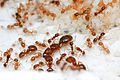 Pheidole ants
 -
 Vervet Monkeys
 -
 Kin selection
 -
 Ipomoea hederacea
.jpg)


.jpg)


