Bulbourethral gland: Difference between revisions
CSV import Tags: mobile edit mobile web edit |
CSV import |
||
| Line 24: | Line 24: | ||
{{anatomy-stub}} | {{anatomy-stub}} | ||
<gallery> | <gallery> | ||
File:Prostatic_urethra.svg|Diagram of the prostatic urethra | |||
File:Pre_cum_160717.jpg|Pre-ejaculate fluid | |||
File:Illu_penis.jpg|Illustration of the penis | |||
File:Gray1136.png|Anatomy of the male pelvis | |||
File:Gray1156.png|Male reproductive system | |||
File:Gray543.png|Bulbourethral gland | |||
</gallery> | |||
<gallery> | |||
File:male_anatomy_1.png|Male anatomy overview | |||
File:Bulbourethral_gland_--_very_high_mag.jpg|Bulbourethral gland under very high magnification | |||
File:Prostatic_urethra.svg|Diagram of the prostatic urethra | File:Prostatic_urethra.svg|Diagram of the prostatic urethra | ||
File:Pre_cum_160717.jpg|Pre-ejaculate fluid | File:Pre_cum_160717.jpg|Pre-ejaculate fluid | ||
Revision as of 11:17, 18 February 2025
Bulbourethral gland
The bulbourethral gland, also known as Cowper's gland, is a part of the male reproductive system. It is one of the glands that contribute to the composition of semen.
Anatomy
The bulbourethral gland is a small, pea-sized organ that is located in the pelvis, within the sphincter urethrae muscle. It is found in the deep perineal pouch, closer to the membranous urethra. Each male has two of these glands, one on either side of the urethra.
Function
The primary function of the bulbourethral gland is the production of a clear, viscous secretion known as pre-ejaculate or Cowper's fluid. This fluid is released before ejaculation, and serves several purposes. It neutralizes the acidity of the urethra, which can be harmful to sperm. It also lubricates the urethra, facilitating the passage of sperm during ejaculation.
Clinical significance
Diseases of the bulbourethral gland are relatively rare. However, they can include inflammation (Cowperitis), abscess formation, and neoplasms. These conditions can cause symptoms such as pain, swelling, and discharge from the penis. Treatment typically involves antibiotics for infections, and surgery for abscesses or neoplasms.
See also

-
Diagram of the prostatic urethra
-
Pre-ejaculate fluid
-
Illustration of the penis
-
Anatomy of the male pelvis
-
Male reproductive system
-
Bulbourethral gland
-
Male anatomy overview
-
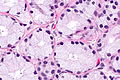 Bulbourethral gland under very high magnification
 -
Diagram of the prostatic urethra
-
Pre-ejaculate fluid
-
Illustration of the penis
-
Anatomy of the male pelvis
-
Male reproductive system
-
Bulbourethral gland


