Auricle (anatomy): Difference between revisions
CSV import Tags: mobile edit mobile web edit |
CSV import |
||
| Line 35: | Line 35: | ||
{{anatomy-stub}} | {{anatomy-stub}} | ||
<gallery> | |||
File:Gray904.png|Auricle (anatomy) | |||
File:Fennecus_dormiens.jpg|Fennec fox sleeping | |||
File:Female_impala_headshot.jpg|Female impala headshot | |||
File:Ear_with_earring.jpg|Ear with earring | |||
File:Slide2COR.JPG|Auricle (anatomy) | |||
File:Slide3COR.JPG|Auricle (anatomy) | |||
File:Slide4COR.JPG|Auricle (anatomy) | |||
File:Large,_rounded,_well-defined_male_ear.jpg|Large, rounded, well-defined male ear | |||
</gallery> | |||
Latest revision as of 11:16, 18 February 2025
Auricle (anatomy)
The auricle or pinna is a prominent part of the anatomy of the ear. It is the visible part of the ear that resides outside of the head, also known as the external ear. The auricle plays a crucial role in the human auditory system, primarily aiding in sound localization.
Structure[edit]
The auricle is composed of a thin plate of yellow elastic cartilage, covered with integument, and connected to the surrounding parts by ligaments and muscles; and to the ear drum or tympanic membrane, by a narrow tube, the external auditory meatus.
Parts of the Auricle[edit]
The auricle can be divided into several parts:
- Helix: The rim of the auricle, which starts just above the earlobe and continues around the ear.
- Antihelix: A curved prominence of cartilage parallel with and in front of the helix.
- Tragus: A small pointed eminence that projects from the front part of the auricle.
- Antitragus: A prominence opposite the tragus at the base of the auricle.
- Concha: The hollow next to the ear canal.
- Lobule: The fleshy, non-cartilaginous lower part of the auricle, also known as the earlobe.
Function[edit]
The primary function of the auricle is to collect sound, and provide directional sensitivity through its anatomy. The irregular shape of the human auricle is a result of its need to gather sound from all directions. This is especially important for vertical sound localization, determining if a sound is coming from above or below.
Clinical significance[edit]
Abnormalities or injury to the auricle can result in hearing impairment. Conditions such as microtia, anotia, and cauliflower ear involve deformities or damage to the auricle. Treatments can range from surgical correction to the use of hearing aids.
See also[edit]

-
 Auricle (anatomy)
 -
 Fennec fox sleeping
 -
 Female impala headshot
 -
 Ear with earring
 -
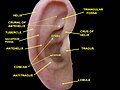 Auricle (anatomy)
 -
 Auricle (anatomy)
 -
 Auricle (anatomy)
 -
 Large, rounded, well-defined male ear


