Corneal transplantation: Difference between revisions
CSV import |
CSV import |
||
| Line 43: | Line 43: | ||
{{medicine-stub}} | {{medicine-stub}} | ||
<gallery> | |||
File:Cornea_transplant.jpg|Corneal transplantation | |||
File:A_human_eye_1_day_after_a_cornea_transplant.jpg|A human eye 1 day after a cornea transplant | |||
File:Cornea_Transplant.jpg|Corneal transplantation | |||
File:Penetrating_keratoplasty.JPG|Penetrating keratoplasty | |||
File:Boston_Kpro_type_1_Titanium_posterior_plate.JPG|Boston KPro type 1 Titanium posterior plate | |||
File:Eduard_Konrad_Zirm.JPG|Eduard Konrad Zirm | |||
File:Ramon_Castroviejo.jpg|Ramon Castroviejo | |||
</gallery> | |||
Latest revision as of 11:15, 18 February 2025
Corneal Transplantation
Corneal transplantation, also known as corneal grafting or keratoplasty, is a surgical procedure where a damaged or diseased cornea is replaced with a donated corneal tissue. The cornea is the transparent front part of the eye that covers the iris, pupil, and anterior chamber. This procedure is critical for restoring vision, reducing pain, and improving the appearance of a damaged or diseased cornea.
Types of Corneal Transplantation[edit]
There are several types of corneal transplantation, each suited for different types of corneal problems:
- Penetrating Keratoplasty (PK): This involves the transplantation of the entire cornea. It is often used for conditions where the full thickness of the cornea is affected.
- Lamellar Keratoplasty: Only layers of the cornea are replaced, which can be anterior or posterior, depending on the part of the cornea that is diseased or damaged.
 * Deep Anterior Lamellar Keratoplasty (DALK): Replaces the front layers of the cornea, keeping the endothelium intact.
 * Descemet's Stripping Endothelial Keratoplasty (DSEK) and Descemet's Membrane Endothelial Keratoplasty (DMEK): These procedures involve the replacement of the endothelial layer of the cornea.
Indications for Corneal Transplantation[edit]
Corneal transplantation is indicated for various corneal diseases and conditions, including:
- Keratoconus: A progressive thinning of the cornea.
- Fuchs' Dystrophy: A degenerative disease of the corneal endothelium.
- Corneal Scarring: Resulting from infections (such as keratitis) or injuries.
- Corneal Ulcers: Including those that do not respond to medical treatment.
- Bullous Keratopathy: A condition causing swelling and blisters on the cornea.
Procedure[edit]
The procedure for corneal transplantation varies depending on the type of keratoplasty being performed. Generally, it involves the removal of the damaged corneal tissue and its replacement with a clear donor cornea. The surgery is usually done under local anesthesia and on an outpatient basis.
Risks and Complications[edit]
As with any surgery, corneal transplantation carries risks, including rejection of the donor cornea, infection, issues with the sutures used to secure the donor tissue, and problems with eye pressure.
Postoperative Care[edit]
Postoperative care is crucial for the success of corneal transplantation. Patients may need to use eye drops to prevent infection and rejection, and follow-up visits are necessary to monitor the healing process. The use of eyeglasses or contact lenses may still be needed after surgery.
Prognosis[edit]
The prognosis for corneal transplantation is generally good, with many patients achieving significant improvements in vision. However, the outcome can vary depending on the underlying reason for the transplantation and the patient's overall health.
See Also[edit]

-
 Corneal transplantation
 -
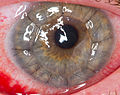 A human eye 1 day after a cornea transplant
 -
 Corneal transplantation
 -
 Penetrating keratoplasty
 -
 Boston KPro type 1 Titanium posterior plate
 -
 Eduard Konrad Zirm
 -
 Ramon Castroviejo


