Paleozoic: Difference between revisions
CSV import |
CSV import |
||
| Line 40: | Line 40: | ||
{{stub}} | {{stub}} | ||
{{dictionary-stub1}} | {{dictionary-stub1}} | ||
<gallery> | |||
File:Trilobite_Heinrich_Harder.jpg|Trilobite illustration by Heinrich Harder | |||
File:Ostracoderm_digital_recreation..jpg|Digital recreation of an Ostracoderm | |||
File:Eogyrinus_BW.jpg|Eogyrinus in black and white | |||
File:Dimetrodon_grandis_in_"high_walk"_pose.png|Dimetrodon grandis in "high walk" pose | |||
File:Life_in_the_early_Paleozoic_Age.jpg|Life in the early Paleozoic Age | |||
File:Swamp_Forest_in_the_Carboniferous_Age.jpg|Swamp Forest in the Carboniferous Age | |||
File:Devonianscene-green.jpg|Devonian scene | |||
</gallery> | |||
Latest revision as of 11:15, 18 February 2025
Paleozoic is a significant era in the Earth's geological history, spanning from approximately 541 to 252.17 million years ago. It is the earliest of three geologic eras of the Phanerozoic Eon, succeeded by the Mesozoic and Cenozoic eras. The Paleozoic era is marked by the proliferation of life forms, including the first appearance of marine life, terrestrial plants, and terrestrial animals.
Overview[edit]
The Paleozoic era is divided into six geologic periods: the Cambrian, Ordovician, Silurian, Devonian, Carboniferous, and Permian. Each period is characterized by specific evolutionary milestones and climatic conditions.
Cambrian Period[edit]
The Cambrian period, lasting from 541 to 485.4 million years ago, is known for the Cambrian explosion, a significant event in the history of life on Earth during which most major animal phyla appeared.
Ordovician Period[edit]
The Ordovician period, from 485.4 to 443.8 million years ago, saw the diversification of early marine life, such as brachiopods, trilobites, and the first true fish.
Silurian Period[edit]
The Silurian period, from 443.8 to 419.2 million years ago, is marked by the first evidence of life on land, including the emergence of terrestrial plants and arthropods.
Devonian Period[edit]
The Devonian period, from 419.2 to 358.9 million years ago, is known as the "Age of Fishes" due to the diversification of fish species. It also saw the first appearance of seed-bearing plants and the first terrestrial vertebrates.
Carboniferous Period[edit]
The Carboniferous period, from 358.9 to 298.9 million years ago, is characterized by the formation of extensive coal forests and the evolution of the first amniotes, a group of tetrapods that includes the ancestors of all modern reptiles, birds, and mammals.
Permian Period[edit]
The Permian period, from 298.9 to 252.17 million years ago, ended with the largest mass extinction in Earth's history, the Permian–Triassic extinction event, which wiped out about 90% of all species.
See Also[edit]
 | |
|---|---|
 |
 |
-
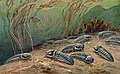 Trilobite illustration by Heinrich Harder
 -
 Digital recreation of an Ostracoderm
 -
 Eogyrinus in black and white
 -
 Dimetrodon grandis in "high walk" pose
 -
 Life in the early Paleozoic Age
 -
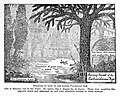 Swamp Forest in the Carboniferous Age
 -
 Devonian scene


