N-linked glycosylation: Difference between revisions
CSV import Tags: mobile edit mobile web edit |
CSV import |
||
| Line 24: | Line 24: | ||
{{cell-bio-stub}} | {{cell-bio-stub}} | ||
{{molbio-stub}} | {{molbio-stub}} | ||
<gallery> | |||
File:Variety_of_glycans.svg|Variety of glycans | |||
File:Biosynthesis_of_N-glycan.svg|Biosynthesis of N-glycan | |||
File:N-glycan_precursor_synthesis_in_the_ER_lumen.png|N-glycan precursor synthesis in the ER lumen | |||
File:Glycan_processing_in_the_ER_and_Golgi.png|Glycan processing in the ER and Golgi | |||
File:Types_of_glycans.svg|Types of glycans | |||
File:Difference_between_animal_and_human.svg|Difference between animal and human | |||
</gallery> | |||
Latest revision as of 11:15, 18 February 2025
N-linked glycosylation is a critical biological process that involves the attachment of a glycan (sugar molecule) to a nitrogen atom in the amino acid asparagine, found in a protein. This process is a form of protein modification that can influence the protein's function, stability, and cellular location.
Process[edit]
N-linked glycosylation occurs in the endoplasmic reticulum (ER) and Golgi apparatus of a cell. The process begins in the ER, where a pre-assembled oligosaccharide is transferred to the nascent protein. This oligosaccharide is then modified as the protein travels through the ER and Golgi apparatus. The final glycosylated protein can have a variety of complex structures, depending on the specific modifications that have occurred.
Function[edit]
The addition of a glycan to a protein can have several effects on the protein's properties. It can influence the protein's folding, stability, and function. It can also serve as a signal for the protein's cellular location. For example, certain glycans can direct a protein to the cell surface or to specific organelles within the cell.
Clinical significance[edit]
Abnormalities in N-linked glycosylation can lead to a variety of diseases, known as congenital disorders of glycosylation (CDG). These disorders can affect many different systems in the body, leading to symptoms such as developmental delay, organ dysfunction, and neurological problems.
See also[edit]
.svg)
This article is a biochemistry stub. You can help WikiMD by expanding it!
This cell biology related article is a stub. You can help WikiMD by expanding it.
This molecular biology related article is a stub.
-
 Variety of glycans
 -
 Biosynthesis of N-glycan
 -
 N-glycan precursor synthesis in the ER lumen
 -
 Glycan processing in the ER and Golgi
 -
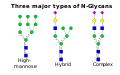 Types of glycans
 -
 Difference between animal and human


