Chloroalkyl ether: Difference between revisions
CSV import Tags: mobile edit mobile web edit |
CSV import |
||
| Line 27: | Line 27: | ||
{{Chem-stub}} | {{Chem-stub}} | ||
<gallery> | |||
File:(Chlormethyl)methylether.svg|(Chlormethyl)methylether | |||
File:Benzyl_chloromethyl_ether.svg|Benzyl chloromethyl ether | |||
File:(Chlormethyl)methylether.svg|(Chlormethyl)methylether | |||
File:Bis(chloromethyl)_ether.svg|Bis(chloromethyl) ether | |||
File:T-Butoxymethyl_chloride.svg|T-Butoxymethyl chloride | |||
File:Methoxyethoxymethyl_chloride.svg|Methoxyethoxymethyl chloride | |||
File:Dichloromethyl_methyl_ether.svg|Dichloromethyl methyl ether | |||
</gallery> | |||
Latest revision as of 11:14, 18 February 2025
Chloroalkyl ethers are a group of chemical compounds that contain an ether functional group with one or more chlorine atoms attached to the alkyl group. These compounds are significant in various industrial applications, including the production of pharmaceuticals, agrochemicals, and plastics. They are also used as intermediates in the synthesis of other chemical compounds.
Properties and Structure[edit]
Chloroalkyl ethers are characterized by their structure, which includes an ether group (an oxygen atom connected to two alkyl or aryl groups) and one or more chlorine atoms attached to the alkyl chain. The presence of chlorine gives these compounds unique properties, such as increased reactivity and solubility in organic solvents, compared to their non-chlorinated ether counterparts.
Synthesis[edit]
The synthesis of chloroalkyl ethers typically involves the reaction of alcohols with chlorinating agents. One common method is the Williamson ether synthesis, where an alkoxide ion reacts with a primary alkyl halide. In the case of chloroalkyl ethers, a chloroalkyl halide would be used as the substrate. Another method involves the direct chlorination of an ether, where the ether undergoes a substitution reaction with a chlorine source.
Applications[edit]
Chloroalkyl ethers find applications in various fields due to their unique chemical properties. In the pharmaceutical industry, they are used as intermediates in the synthesis of active pharmaceutical ingredients (APIs). In the field of agrochemicals, they serve as precursors for the production of pesticides and herbicides. Additionally, chloroalkyl ethers are used in the manufacture of certain plastics, providing enhanced durability and chemical resistance.
Safety and Environmental Concerns[edit]
The handling and use of chloroalkyl ethers require caution due to their potential health and environmental impacts. Many chloroalkyl ethers are toxic and can cause irritation to the skin, eyes, and respiratory system upon exposure. Furthermore, some chloroalkyl ethers are considered persistent organic pollutants (POPs), posing long-term risks to the environment due to their stability and ability to bioaccumulate.
Regulation[edit]
Due to their potential health and environmental hazards, the production and use of chloroalkyl ethers are regulated under various international and national chemical safety standards. Regulations may include restrictions on their use in certain applications, requirements for safe handling and disposal, and monitoring of emissions and residues in the environment.
See Also[edit]

-
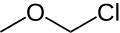 (Chlormethyl)methylether
 -
 Benzyl chloromethyl ether
 -
(Chlormethyl)methylether
-
 Bis(chloromethyl) ether
 -
 T-Butoxymethyl chloride
 -
 Methoxyethoxymethyl chloride
 -
 Dichloromethyl methyl ether
methylether.svg)

_ether.svg)


