Japanese rice: Difference between revisions
CSV import Tags: mobile edit mobile web edit |
CSV import |
||
| Line 32: | Line 32: | ||
{{Japanese cuisine}} | {{Japanese cuisine}} | ||
{{food-stub}} | {{food-stub}} | ||
<gallery> | |||
File:Stages_of_rice_milling.jpg|Stages of rice milling | |||
File:TawaramotoRiceField.png|Rice field in Tawaramoto | |||
File:Koshihikari_and_calrose_rice.jpg|Koshihikari and Calrose rice | |||
File:Hiroshige_Bowl_of_Sushi.jpg|Bowl of sushi by Hiroshige | |||
File:Edo_Kamado.JPG|Traditional Edo period kamado | |||
File:Japanese_rice_in_Wajima-nuri_lacquerware.jpg|Japanese rice in Wajima-nuri lacquerware | |||
</gallery> | |||
Latest revision as of 11:13, 18 February 2025
Japanese rice refers to a number of short-grain cultivars of Japonica rice including ordinary rice (uruchimai) and glutinous rice (mochigome).
Overview[edit]
Japanese rice is a staple part of the Japanese cuisine. It is used in a variety of dishes, including sushi, onigiri (rice balls), and donburi (rice bowls). The rice is known for its unique stickiness and texture, which is achieved through a high content of a specific type of starch called amylopectin.
Varieties[edit]
There are several varieties of Japanese rice, each with its own unique characteristics and uses.
Uruchimai[edit]
Uruchimai is the most common type of Japanese rice, and is used as an everyday staple by the Japanese people. It is a short-grain rice, and becomes sticky when cooked.
Mochigome[edit]
Mochigome is a type of glutinous rice used in Japan. Despite its name, it does not contain gluten, but rather a higher amount of starch. This rice is used for making mochi (rice cakes) and traditional sweets.
Cultivation[edit]
Japanese rice is cultivated in all parts of Japan, although the prefectures of Niigata, Akita, and Ibaraki are particularly well-known for their rice production. The rice is typically planted in the spring and harvested in the autumn.
Preparation[edit]
Japanese rice is typically rinsed before cooking to remove the bran layer and any remaining rice powder. It is then soaked in water for a period of time before being cooked. The rice is usually cooked in rice cookers, but can also be cooked in a pot on the stove.
Cultural significance[edit]
Rice is deeply ingrained in Japanese culture and traditions. It is not only a staple food, but also used in various festivals and ceremonies. For example, during the New Year's celebrations, it is common to make mochi, a type of rice cake, from mochigome.
See also[edit]
| Japanese cuisine 日本料理 |
|---|
|
|

-
 Stages of rice milling
 -
 Rice field in Tawaramoto
 -
 Koshihikari and Calrose rice
 -
 Bowl of sushi by Hiroshige
 -
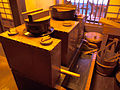 Traditional Edo period kamado
 -
 Japanese rice in Wajima-nuri lacquerware


